
![3 Ways Small Business Website Projects Fail | Prep and Timeline Before You Order [2026]](/assets/posts/thumb-website-order-guide.avif?v=763694b8)
Hi, I’m Kurita, Representative Director of Webharu Inc.. I normally run the production-company side that issues the quote.
The conclusion first. When commissioning a website for a small or midsize business fails, it almost always comes down to one of these three things.
- Getting a quote with no preparation, so the prices can’t be compared
- Waiting on approvals piling up, so the schedule doubles
- No exit written into the contract, so there’s nothing to walk away with when you stop
All three are preventable with preparation before you pick a production company, and with checks before you sign. Which company you hire is, in fact, a later question.
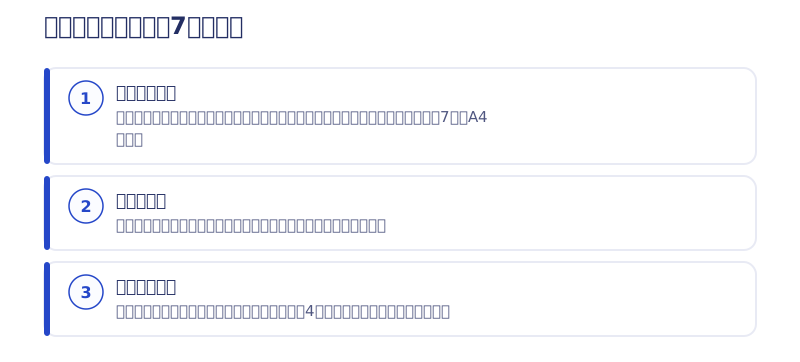
Key takeaways
- Website project timeline — what it means
- A website project's timeline can mean two different things: the build period from once the content is settled in discovery through to launch, or the time from the first consultation to launch. Webharu's guide: the build period is at least 2–3 months for both AI Website Production and an original design, and there are meetings before that (as of October 2026).
Contents
A common failure in small business website projects: the schedule doubles
The most common failure is the planned schedule stretching to double its length. The cause is almost never the production company’s own work — it’s approvals waiting on the client’s side.
A project planned for six months that took a year
Here’s a failure of my own. A project I scheduled to finish in about six months ended up taking roughly a year.
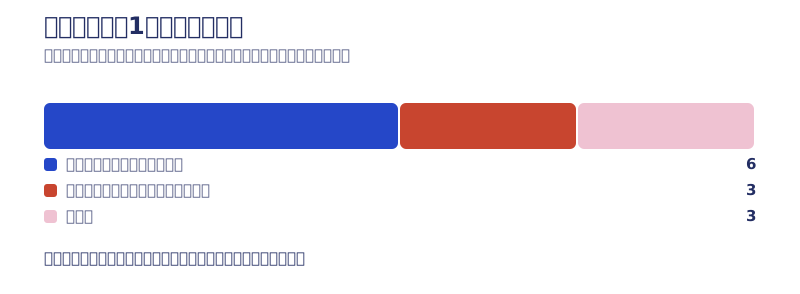
The approval phases alone piled up to about three months in total. We were delivering on schedule at every stage, and the quote had allowed one to two weeks for each round of approval. In practice, though, it took a month to approve the design, a month to approve the copy, and another month for the final check once it was finished.
There were almost no requests for major revisions. Nobody argued, and the direction never flip-flopped. The schedule simply doubled because nobody could find the time to look at it.
There’s something to reflect on in how I quoted it, too. I’d set the assumption of “one to two weeks for approval” without checking the client’s actual workload. These days, before we start, I ask up front how much time they think they can set aside for approvals, and who will give the final sign-off. There’s only one thing I’d ask of anyone commissioning a site: tell us honestly, up front, how much time you can actually give to approvals. Say “we’re in our busy season, we can’t look at this for two weeks” and we can build a schedule around it.
Five things to have ready so the schedule doesn’t stretch
Whether these are ready makes a big difference to how long decisions take.
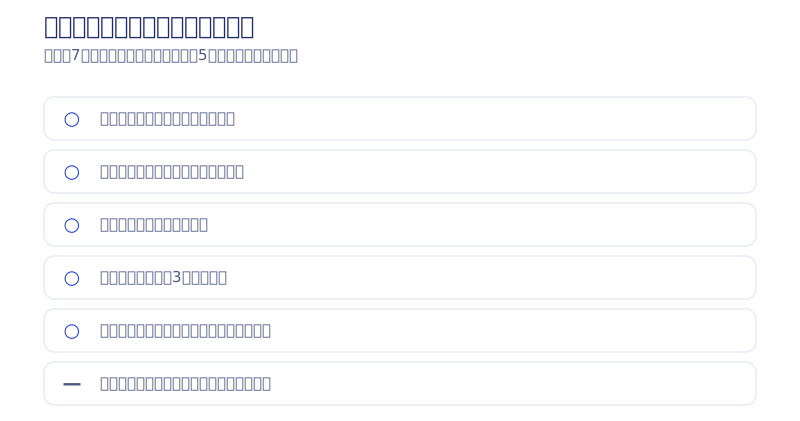
Color codes, the logo file, photos, three design references, and being able to put what you want into words. Have those five ready and decisions go faster. “Leave it all up to you” works too, but then the time spent deciding rides straight into the schedule.
Website timelines: at least 2–3 months
How long a website project takes depends on whether you mean the builder’s own work period, or the time from the first consultation to launch. Here’s Webharu’s guide (as of October 2026).
| How it’s built | Price (excl. tax) | Typical build time |
|---|---|---|
| AI Website Production (standard configuration) | from ¥1,000,000 | at least 2–3 months |
| Full-Scratch Website Build (original design) | from ¥1,000,000 | at least 2–3 months |
| Web Application Development | from ¥2,500,000 | about 2–4 months |
The times in that table are the build period from once the content is settled in discovery through to launch. Hear the brief, pull the information together, build and check it, check the design, launch and check again. Because of those steps, it can’t be made shorter even with AI.
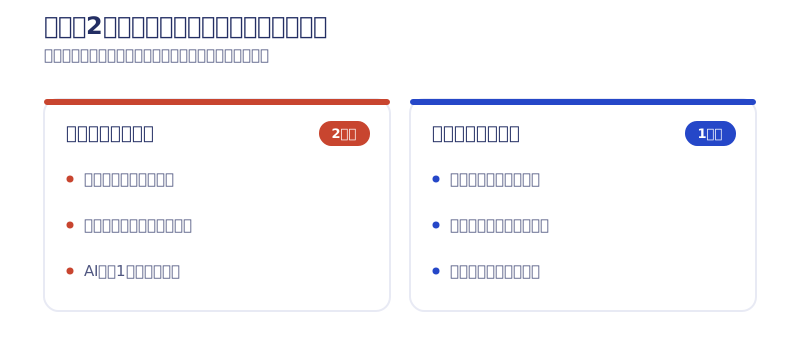
Some articles say “it’s fast because we use AI.” In practice, a person reviews the code AI writes, every page is built properly, and we bring all of our knowledge and experience to bear. Because that review and build take time, a Webharu website takes at least 2–3 months. When a company tells you “we can do it in two weeks,” always confirm exactly what that period covers, start to finish.
Even for a small site, we spend time on planning and structure. For a redesign, we start by tracking down why the current site isn’t producing results. AI shortens the time it takes to build; it does not shorten the time it takes to decide and to verify.
What AI brought down is the price of large sites
What AI changed is not the timeline but the price of large sites: a site that used to cost around ¥8–15 million can now be built for roughly ¥3–5 million.
“Are there really sites that expensive?” you might wonder. In deals with large companies, those figures are normal. A large company that handles a lot of data simply won’t outsource to a firm that takes the job for around ¥1 million.
Meetings alone can take three months before building starts
On top of that, the work starts with meetings. Among the companies I’m working with now, one has been in nothing but meetings for three months.
For pre-order meetings, that is honestly long, and sometimes I worry the order will never come. Still, I think long meetings are part of how business-to-business deals work. It is also the stage where our research and the answers we bring earn the client’s trust.
Even rebuilding our own site, the time went into deciding, not building
When Webharu rebuilt our own company site with AI (Claude Code) in July 2026, it took seven days: four days of planning, three days of building. In those four planning days, we had the AI produce around 50 design variations and narrowed them down from there. Even at the scale of building 26 pages and migrating 62 articles, the time went into deciding rather than building. It was our own site, so I was the only one deciding and checking. A client site doesn’t move at that pace. The record is in the full process of fully renewing a site with AI.
4 things to ask about timeline in a quote
- Does that period include organizing requirements and planning?
- How many rounds of design approval are included, and how many business days is each round expected to take?
- What’s the cap on revision rounds, and what happens to the price and schedule beyond it?
- How long is initial post-launch support, and what does it actually cover?
Whether you can meet in person barely affects the timeline at all. About 20% of Webharu’s projects are overseas, 60–70% are elsewhere in Japan, and only about 10% are in Sendai or Miyagi — we run almost all of it online.
7 things to settle before you request a quote
Nobody can quote until what you’re building is decided. Send an inquiry while it’s still vague and every firm quotes on a different set of assumptions, which makes the prices impossible to compare. Put the following seven on a single sheet of paper before you make the request.
- Purpose: what do you want the site to make happen (inquiries, recruitment, or just a digital business card). Narrow it until it fits in one sentence
- Audience: decide it to about the resolution of “people in their 40s to 60s around Sendai considering exterior wall painting”
- Reference sites: two or three, each with a reason. Visual preference and industry proximity are separate axes, so having both helps
- Update arrangements: after launch, who updates it and how often. This is what decides whether you need a CMS and how the maintenance fee gets structured
- Budget: decide it as a total — initial fee + monthly fee × 36 months + termination costs — not just the initial fee
- Copy and photos: will you prepare them yourselves, or ask the company to write and photograph too. Waiting on copy is the classic place a schedule stalls
- Definition of success: decide it numerically, as in “three inquiries a month”
It’s fine if you can’t fill in all seven. If you want to start by settling what to build in the first place, Webharu takes on the Requirements Definition Phase (from ¥100,000, excl. tax) on its own. If you move on to the full contract, that fee goes entirely toward the build cost (see our pricing page).
Why that budget formula matters is written up in the downsides of subscription-style websites. Which numbers to watch after launch are in the five numbers a manager should check every month.
Run competitive quotes by handing every firm the same document
Do get competitive quotes. Coming from someone who receives them, you can trust that — the more honest a company is, the less it minds being compared.
- Hand the same single sheet of the seven items to every firm, on identical terms
- Compare the breakdown — what’s included and what costs extra — rather than which number is bigger
- Ask the salesperson about page count, what happens on termination, real examples of their design work, and what their traffic-building measures actually consist of
If you’re set on building in Webflow, the five things to look for in a quote are in how to choose a Webflow production company. If you’re still undecided between WordPress, Webflow, or an AI build, start with moving from WordPress to Webflow, and how to choose what to build with.

4 clauses to check in the contract
Once you’ve settled on one firm, the contract is next. Reading the whole thing is ideal, but at minimum check these four. In short, it comes down to: when you part ways with this company, what can you walk out with?
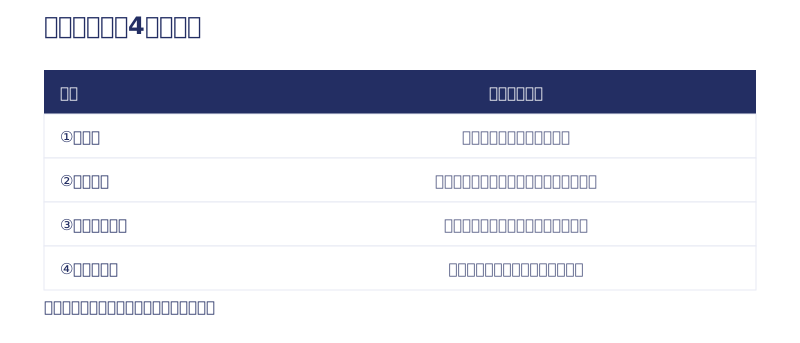
Ownership of the site and the domain
Always register the domain (the URL, as in yourcompany.com) in your own company’s name. In the production company’s name, you can lose the URL you spent years growing the moment the contract ends. Confirm who owns the site data and the admin accounts in the contract too, not as a verbal promise.
Termination conditions
Is there a minimum contract term? How much is the cancellation fee? What happens to the site if you cancel? On a monthly-fee contract, this single clause can move the total by a lot.
Copyright and the exit route for data
Is copyright in the deliverables transferred, or does it stop at a license? When the contract ends, will they hand over the copy, images, and design files?
On a project where Webharu moved over 100 articles from WordPress to Webflow, what we actually got was access to the WordPress admin panel. With that alone, every article can be exported as CSV, so we could move the whole lot without changing a single URL. Having the exit route for data secured means your own company holds the permissions to touch the content. Under a contract with no such permissions, you start by copying and pasting articles back out one at a time, and both cost and timeline balloon immediately.
There was also something we didn’t get on that project: the numbers after launch. Our remit on that job ended at the build and the basic SEO setup, so we still don’t know what happened to the rankings after the migration. Write “after launch, which numbers, by whom, how often” into the purchase order or the contract somewhere. Without it, the next year arrives with nobody able to judge whether the rebuild actually made things better.
Scope of maintenance work
What’s included in the monthly maintenance fee? Is the boundary written down in words — “updates up to N times a month,” “adding a page costs extra”? Sign with this left vague and every request after launch turns into a negotiation over additional fees. How to read what’s inside a maintenance fee is covered in whether a website can really have no running cost.
The negotiation that beats haggling
When a quote comes in over budget, I don’t recommend simply asking for a discount. Production is made of people’s time, so whatever gets discounted ends up cut from the parts of the process that are hard to see, like design and testing.
Propose something instead that actually lowers the production company’s own costs.
- Prepare the copy and photos entirely in-house
- Designate one point of contact for feedback, and batch your revision requests
- Narrow the page count and features at the start, and add once results come in
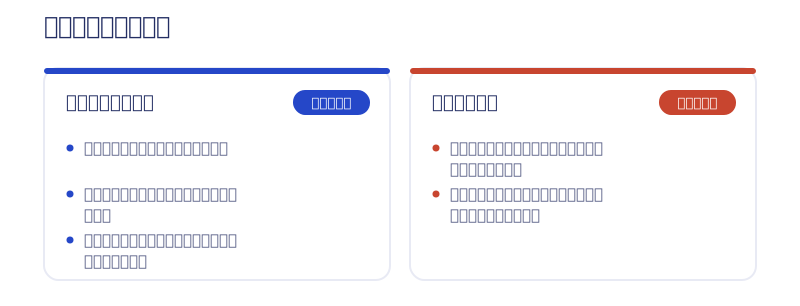
The same reduction in price, but haggling cuts quality while lowering costs cuts waste. Any decent company should be glad to reflect it in the number.
To keep a small business website project from failing
The seven preparations make quotes comparable, declaring your available approval time up front keeps the schedule from stretching, and the four clauses secure your safety for the day you stop. Get this far and you won’t go badly wrong whichever company you choose.
Even just “are our seven items in a state where we can request quotes?” is a fine question to bring us. Send it through the contact form. The full picture on timelines and pricing is on the pricing page.
Selected work

New Paint
No.1 in Japan for its local painting keyword 8 days after launch (Search Console)

Hosted by Nippon TV
High-fidelity Figma-to-Webflow conversion, with load speed and responsiveness optimized

PonTech Lab Inc.
Built with AI (Claude Code) on Next.js and Cloudflare, with the build process published
FAQ
What are the common failures in small business website projects?
Three: no preparation means quotes can't be compared, approvals left waiting double the schedule, and a contract with no exit. Even at Webharu, a project planned for six months once stretched to about a year because approval waiting piled up to three months total.
How long does a website project take?
Webharu's build-time guide is at least 2–3 months for both AI Website Production and an original-design Full-Scratch Website Build, and about 2–4 months for Web Application Development (as of October 2026). There are meetings before that, and some projects spend three months on them.
What should I prepare to get a website project done quickly?
Five things: color codes, the logo file, photos, three design references, and being able to describe what you want in words. The more of them you have ready, the less time goes into deciding.
What should I decide before ordering a website?
Seven things: purpose, audience, two or three reference sites with reasons, post-launch update arrangements, a total budget, who prepares the copy and photos, and a numeric definition of success. Put them on a single sheet and hand every firm the same document, and you can compare quotes on identical terms.
What should I check in a website production contract?
Four clauses: ownership of the site and domain, termination conditions, copyright and the exit route for data, and the scope of maintenance work. Also write into the purchase order or contract which numbers get checked after launch, by whom, and how often.
Can I ask for help even if I haven't decided what to build?
Yes. Webharu takes on the Requirements Definition Phase (from ¥100,000, excl. tax) on its own. If you move on to the full contract, that fee goes entirely toward the build cost.


