

Hi, I’m Kurita, Representative Director of Webharu Inc.. I was born and raised in Shiogama, and today I run the web production company Webharu Inc. out of Shiogama, Miyagi.
Let me start with the conclusion, for anyone considering website production in Shiogama, Miyagi.
- We are a production company where the founder, a Shiogama native, handles the work directly (based in Shiogama, Miyagi)
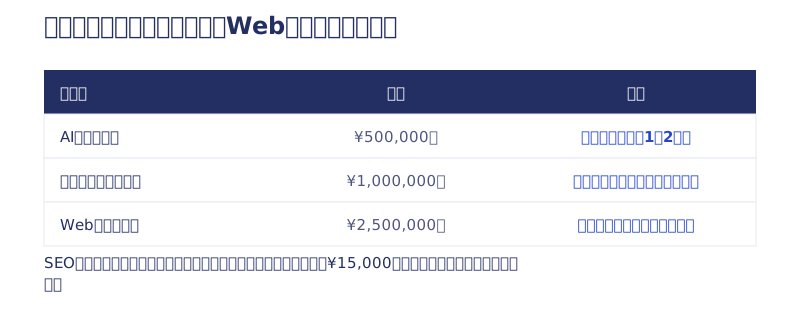
- Pricing: AI Website Production from ¥1,000,000 / Full-Scratch Build from ¥1,000,000 (excl. tax, starting prices)
- For a painting company in Shiogama we produced a website and flyers, and supported their application for the Small Business Sustainability Subsidy, which was approved
- Built to keep running costs light after launch (our own site runs on ¥1,500 a year in domain fees alone)
Key takeaways
- website production in Shiogama — what it means
- Website production in Shiogama means building a website that acts as an online sign for businesses in Shiogama, Miyagi Prefecture, Japan. Webharu Inc., founded by a Shiogama native and based in Shiogama, Miyagi, produces sites from ¥1,000,000 (excl. tax) for AI Website Production, and also supports applications for the Small Business Sustainability Subsidy.
Contents
Website production in Shiogama: Webharu’s pricing, track record and process
Let me get the business part out of the way first. The heart of this article is what comes after — why I stay attached to Shiogama — but what anyone considering a request wants to know first is the price and the track record.
Pricing (excl. tax, as of 2026, starting prices)
- AI Website Production: from ¥1,000,000 — standard configuration, at least 2–3 months
- Full-Scratch Website Build: from ¥1,000,000 — an original design engineered from zero, with SEO setup, analytics and forms included
- After launch: from ¥15,000/month if you want us to handle updates. If you keep it yourself, upkeep can stay at roughly the cost of a domain
The full picture is on our pricing page. For the wider market rate, see what website production costs in Sendai (Japanese).
Subsidies can lower what you actually pay
Small businesses in Shiogama may qualify for the Small Business Sustainability Subsidy (a Japanese national subsidy). We supported the application for a painting company in Shiogama, and it was approved (the true story of building a website with a subsidy (Japanese)). Note that approval can never be guaranteed.
Our work in Shiogama
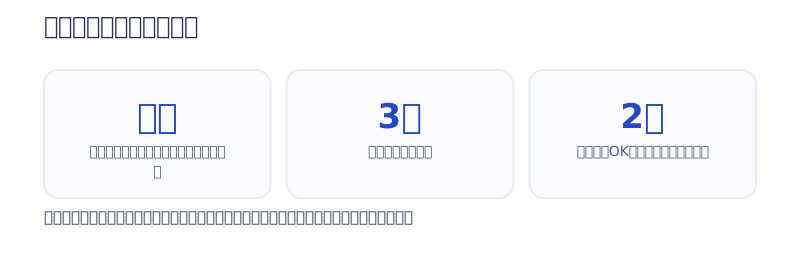
For that painting company we produced a website and flyers and walked them through the subsidy application. The result: three jobs won through the flyers. I wrote up the details in how website marketing actually works for painting and construction firms (Japanese).
The process (three steps)
- Get in touch (online, or in person in Shiogama or Sendai)
- Interview and estimate — we sort out the goal, the budget and the subsidy options together
- Production and launch (at least 2–3 months). Marketing and operations after launch are on the table too
Why I stay attached to website production in Shiogama (my own story from here on)
This article is about what I can give back to Shiogama through the work of website production, and why I want to build sites specifically here — told through my own past.
Web production works regardless of geography, so there is no need at all to fixate on Shiogama. And yet I do keep marketing here. I have handed out flyers, run web ads, and asked people for referrals.
So here is why someone who has built up a reasonable track record in web production is still attached to his hometown of Shiogama.
Thirteen years ago I could do nothing for Shiogama. Today, websites I can do.
Thirteen years ago I could do nothing for Shiogama.
Thirteen years ago came the earthquake and tsunami. I was in my second year of middle school. I had finished the graduation ceremony for the year above at Shiogama Daiichi Junior High and was at home getting ready for baseball practice. Then the quake hit out of nowhere. Every window in the house blew out; dishes, books, the TV, everything churned together. The house was half-destroyed. We evacuated to my aunt’s and got through the disaster there.
There was no food back then, and someone had to go out to a supermarket. All we could do was split into groups and go round the stores across the area. But I could barely do anything at all. I remember being astonished that panic could stop a person moving that completely.
The usual route to school, the usual park, my own usual house — all of it felt frightening. It was like being in a post-apocalyptic manga. I kept feeling, for no good reason, that the streets had turned dangerous and that going out now meant someone might attack me.
What saved me then were the neighbors. We had not talked much lately, but in the disaster everyone cooperated and helped one another in all sorts of ways. (When I was small we talked all the time.)
They gathered every day and spoke calmly — “are you all right?”, “do you need anything?”, “that supermarket was open” — and thanks to that I could think, everyone is living as usual. Gradually I was able to go outside again.
After that I went to the supermarkets myself, and to the places the tsunami had reached. There I saw a great many adults working on the recovery. This was less than two weeks after the disaster. While I was shaking at home, many people from Shiogama were moving for the people of Shiogama.
And once school started again, one of my friends told me he had been volunteering at the school the whole time since the disaster.
It floored me.
I had done nothing but tremble, and someone my own age had been working for other people. I wanted to do something myself. Was there anything I could do? In the end — I did nothing.
Today, websites I can do.
People have all sorts of roles. Some friends do painting work, others run renovation firms. People a few years ahead of me have opened restaurants or started cleaning businesses. All of them contribute to lifting the region simply by doing business in Shiogama and Sendai.
As for me, I produce websites, working online with companies all over Japan. Nothing to do with Shiogama at all, on the face of it.
But it struck me that I can help Shiogama’s businesses. I have in fact built a website for a painting company in Shiogama and helped with their customer acquisition. I have also filed a national subsidy application on a client’s behalf and produced flyers.
So I decided that the role I can play for Shiogama is “producing websites for the people working hard in Shiogama, and spreading what makes them worth visiting”.
Back then I could do nothing but tremble, but websites I can do.
I simply want to compete inside the frame of my hometown, Shiogama (the business case included)
There is of course a business view in it too: competing inside the frame of my hometown, Shiogama, ought to be a somewhat easier fight.
When you work online with competitors across the country — across the world, really — you start to envy locally rooted businesses. You build local ties, and you get to say things like “I took on the renovation for that shop the other day” or “I do the cleaning at that clothing store”.
Having customers within eyeshot really does seem to bring a sense of purpose and achievement. Online work is rewarding too, of course. But there is something good about having helped the shop you always go to.
There is also the plain fact that fewer competitors makes it an easier fight as a business. Call it a locally embedded business. At any rate, if I can compete on something that is only possible in Shiogama, I never have to compete with people in Tokyo, which is a relief. (Admittedly, with website production that is close to impossible.)
Ideally I would like to run free website-production workshops in Shiogama, or talks on what digital transformation gets a restaurant.
Shops in Shiogama basically do no marketing at all (regulars keep them going)
Why it is so hard to visit Shiogama’s independent sushi restaurants
Shiogama has a great many excellent independent shops. All of them spread by word of mouth, and all of them cheap and delicious. But finding them any other way is close to impossible, because none of them are registered on Google Maps, a website, or social media.
Shiogama is said to be the town with the most sushi restaurants per capita in Japan. You would therefore expect fierce competition among sushi restaurants and constant crowds — except that is not quite how it is.
The places with lines in Shiogama are ones like Shiogamako (Japanese), which television made famous, and locally renowned high-end restaurants such as Shirahata (Japanese), Kameki (Japanese) and Sushi Tetsu.
Those popular places are busy, and being high-end they need a reservation as well. (Popular enough to open branches in Sendai.) But as I wrote above, Shiogama is the town with the most sushi restaurants per capita in Japan. There are plenty of independent shops besides those four. And yet in the 27 years since I was born in Shiogama, even I, a resident, have never been to any of the others.
The reason is simple: “I do not know anything about it, and it would be frightening to walk in and find it expensive.” In this day and age, without information on price, taste, portion size and how formal it is, it is far too much of a gamble to drop in casually.
“Can I go in dressed like this? What if it is not good? Are they even open today? Cash only? Do they take credit cards? How much will I need? Is the chef a nice person…?”
All of that and more genuinely runs through your head. And the result is: “it is expensive and needs a reservation, but let us go to the famous one.” Anyone in their twenties today would land there. I do.
The reason you cannot go to the other independent shops is much the same.
When an unusual, interesting shop opens in Shiogama — a French restaurant, a chocolate specialist — you think “let us try it once”. It does not have to be a new opening either: Chez Nous (Japanese), for example, is a French restaurant everyone in Shiogama knows, and we talked about going there one day back when we were students. Location and frontage may play a part, but this is the internet era. Today’s standard strategy is cheap premises plus online customer acquisition.
The izakaya I worked at as a student had premises in front of Sendai Station, but tucked so far back that you would never find it just walking past. It poured money into online ads, brought customers in, and turned a profit.
The hair salon I went to was the same. Tucked into the darkest corner of an old five-story building, it was like a hideout, with an elevator old enough to be frightening. But by spending on the internet to bring customers in, it kept a steady flow. Cheap rent, maximized profit — that is the trend of the internet era.
Rental spaces have surged in popularity over the last few years. Behind that is the idea that if you can find customers online, the premises hardly matter, which has led many people to go independent and start businesses cheaply in something like a personal salon.
In a world that runs on the internet like this, Shiogama still is not acquiring customers there. Even the famous sushi restaurants above have no website. What I can do is produce websites. If you want customers, the first step is putting up a sign — and a website is a sign on the internet.
What I can give back to Shiogama through website production
Shiogama’s independent shops keep disappearing. I know that is what competition is and that it cannot be helped, and yet: the candy store I went to as a child closed when a Lawson opened; an izakaya I loved folded when a chain moved in; a good ramen shop went the same way when a chain arrived.
Watching shops I loved disappear without ever learning how to compete in the current era is genuinely wasteful, and sad. There is the succession problem too, but used well, the internet can even find successors.
A website is the first step of online customer acquisition. Raise a sign on the internet and put your products and information on it. Customers pick that information up and come to the shop. Bringing that cycle to Shiogama’s independent shops is, I think, the way I can repay this town now.
The reality, though, is that independent shops cannot spend much on the internet. So what I can do is offer a website production service that builds sites inexpensively and keeps running costs as low as possible.
(2026 addendum) I have since rethought this “make it cheap” approach. Leading with low prices leaves both the production and the marketing half-finished, and in the end it does not serve the shop. Today, as written at the top, we design at a proper price all the way through to customer acquisition, and support the cost side by making use of subsidies.
But without seriously working out how it functions as a business, it ends fast. If it does not sustain itself, it cannot continue, and it ends as temporary support and nothing more.
Build a business in Shiogama. Build a company in Shiogama. Keep operating, and keep lifting the whole town — that is the kind of company I want to make.
For now, website production in Shiogama amounts to about two projects, but I want to grow that further and become the outfit people mean when they say “if you want a website built in Shiogama, Webharu is the one”. If you want a website in Shiogama or nearby, I would be glad to hear from you. I read every inquiry myself and propose web marketing that is actually achievable.
(2026 addendum) Our track record has grown since, starting with two painting companies in Shiogama. The latest work is published on the work page.
The goal: found a website production company in Shiogama and lift the town
Let me finish by writing down a simple goal. First I want to produce websites for ten businesses in Shiogama. To get there, I will keep publishing toward Shiogama across media and social platforms.
If you want website production in Shiogama or nearby, please get in touch. I will share everything I know about the website and the web marketing that suit your shop or your business.
If you are considering website production in Shiogama
After writing this article I founded Webharu Inc., and we now do web production and AI development from Shiogama, Miyagi Prefecture. Our work in Shiogama and Sendai is published on the work page.
Pricing starts at ¥1,000,000 for AI Website Production (excl. tax, starting price), and we can propose subsidy options alongside it. Inquiries at the “what would it cost in our case?” stage are welcome. I read every one of them myself.
Get in touch (free consultation)
Selected work

New Paint
No.1 in Japan for its local painting keyword 8 days after launch (Search Console)

Hosted by Nippon TV
High-fidelity Figma-to-Webflow conversion, with load speed and responsiveness optimized

PonTech Lab Inc.
Built with AI (Claude Code) on Next.js and Cloudflare, with the build process published
FAQ
How much does it cost to commission website production in Shiogama?
At Webharu Inc., AI Website Production starts at ¥1,000,000 and a full-scratch build with an original design starts at ¥1,000,000 (both excl. tax, starting prices). SEO setup, analytics and a contact form are included. You can get a rough figure from our pricing simulator.
Can I build a website using a subsidy?
You may qualify for the Small Business Sustainability Subsidy and similar programs. We supported the application for a painting company in Shiogama, and it was approved. Eligibility depends on the program and the round, so approval can never be guaranteed, but we can work alongside you from the paperwork onward.
Do you work outside Shiogama — Tagajo, Shichigahama, Matsushima, Sendai?
Yes. We are based in Shiogama, Miyagi, so we cover the area around Shiogama, all of Miyagi Prefecture, and the whole of Japan online. For businesses nearby, in-person meetings are available.
What does it cost to maintain the site after launch?
With the way we build, keeping the site yourself costs roughly a domain fee (our own site runs at ¥1,500 a year). If you want updates and marketing improvements handled for you, care plans start at ¥15,000/month.
I just want it cheap — how is this different from a ¥980-a-month service?
Budget monthly services are usually structured so that nothing remains yours when you cancel, and so that the total ends up higher (we explain this in our article on how cheap website production really works). We state the production fee up front and deliver the site as your asset.
How long does it take?
At least 2–3 months. It depends on how ready your copy and photos are, so we set the schedule together at the interview.
![3 Ways Small Business Website Projects Fail | Prep and Timeline Before You Order [2026]](/assets/posts/thumb-website-order-guide.avif?v=763694b8)

