

I’m Kurita, representative director of Webharu Inc.
Here’s the conclusion up front. The biggest disadvantage of a subscription-based website is that it costs you the most when you try to leave. Even if you start at ¥0 upfront and ¥980 a month, cancelling can trigger a ¥100,000–300,000 bill for “build costs,” or the site simply disappearing — that design is not unusual. ¥980 is not the price of the website — it is the entry price of a recovery mechanism.
This isn’t opinion — it’s something anyone can verify with a calculator. If there’s a service that builds you a site that actually attracts customers, runs it, and lets you cancel anytime, all for ¥980 a month, please tell me. I don’t believe one exists, because the business model can’t survive.
Key takeaways
- Subscription website — what it means
- A subscription website is a contract model where the upfront cost is minimized and you pay a monthly fee instead. The entry price is low — ¥980 to a few thousand yen a month — but the total is usually recovered through minimum contract terms, cancellation fees, site deletion, or buyouts at cancellation, and some cases bill ¥100,000–300,000 as a retroactive build fee when you cancel.
Contents
Subscription Website Disadvantages: The Going Rate for Cancellation Fees Is ¥100,000–300,000
The most overlooked thing about a subscription website is how much you pay when you leave. From what’s publicly available, two methods are in use.
- Retroactive billing for the waived ¥0 setup fee: ¥100,000–300,000 charged as a build cost at cancellation
- A lump-sum bill for the remaining contract months: at ¥10,000 a month with 10 months left, that’s ¥100,000
Run it for two years, fail to attract customers, and the moment you decide to switch providers, the build cost that was supposedly waived arrives all at once. You simply pay at the exit what you didn’t pay at the entrance.
You can also choose not to pay. But then you abandon everything you spent two years building — the pages, the articles, the URLs, the inquiry funnel. If the provider owns the domain, your search rankings disappear with it. Pay money, or abandon the asset. Cancelling a subscription website tends to come down to that choice.
The Disadvantages of Cheap Website Design Come From Four Mechanisms
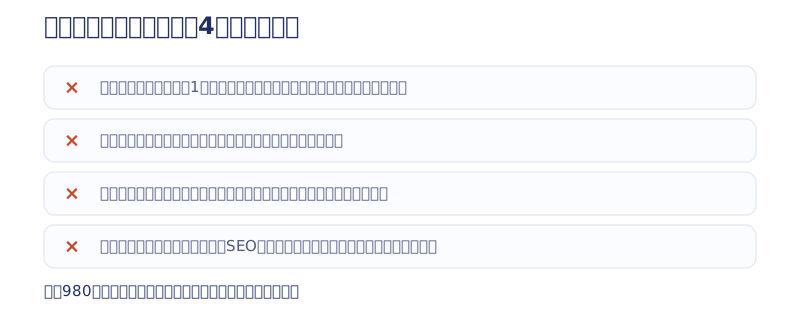
That Monthly Fee Is for One Page Only
The monthly fee in the ad is usually the price of the smallest, single-page plan. Add the pages a normal company site needs — company profile, services, contact, blog — and the monthly fee climbs step by step. Whether the advertised fee actually buys the site you want to build is something the ad will never tell you.
“Original Design” Means Recoloring a Template
The business only works at volume, so designing from zero for each client is structurally impossible. In practice, an existing template just gets a new color and logo. Lately, more of these services say “built with AI” while the actual process is just pouring AI-written text into that same template. I build sites with AI myself, so let me say this plainly: using AI and producing a good site with AI are completely different things.
The Cost Is Built Into the Cancellation
This is the part of the contract I most want you to read. The common pattern is a set of three.
- There’s a minimum contract term and a cancellation fee
- Cancel, and the site is deleted (you don’t get the data)
- Want to keep the site? That’s a buyout (quotes in the hundreds of thousands of yen are not unusual)
Costs Grow Outside the Monthly Fee
Updates capped at a certain number per month, extra pages billed separately, photo swaps as an option, SEO sold as an add-on contract. The cheaper the entry-level monthly fee, the finer the mesh of extra charges. Only once you add three years of fees plus the cost of cancelling do you see the real price.
The Going Rate for Monthly Website Fees, and the Math That Breaks ¥980/Month
The monthly fee for a website changes by an order of magnitude depending on what you’re actually paying for. The subscription type you see in ads commonly runs ¥980 to a few thousand yen a month. WordPress maintenance sits in a ¥10,000–30,000/month range. Webharu’s Site Care Plan is ¥15,000/month and up (as of October 2026, excl. tax), with production costs billed separately.
Now take out a calculator. This isn’t a question of bad intent — it’s a question of arithmetic.
Say the cost of producing one site that actually attracts customers is ¥200,000 (I’ll explain the basis for this in a later section). Recovering that at ¥980 a month takes 204 months — 17 years. And that’s before subtracting a single yen for hosting, support staff, or advertising. Even raised to ¥4,980 a month, it takes 40 months — 3 years and 4 months at zero margin.
- Price it low → margins get thin → you need a large volume of contracts
- Acquire in volume → you need ad spend (which is why you see cheap-website ads on Instagram every day)
- Ad spend can’t be loaded onto the price (because cheap is the whole pitch) → so where does it get recovered?
The answer is the four mechanisms. Recover it through a long contract. Recover it through cancellation fees. Recover it through a buyout. Recover it through add-on charges. All that’s happened is the recovery point moved from the entrance to the exit — the total you pay hasn’t gone down. If anything, you’re paying extra somewhere to cover the ad spend.
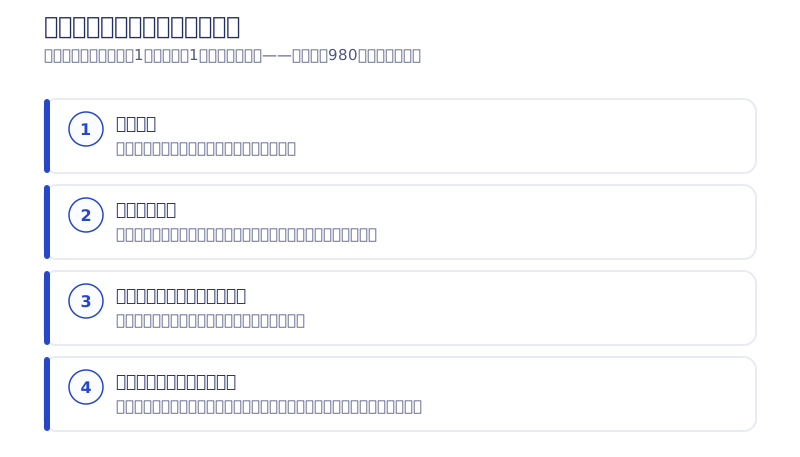
There’s one more thing that simply can’t fit into a ¥980 unit price: time spent in meetings about your company. Understanding your industry, researching competitors, designing an acquisition plan — none of that fits into that price. So the ultra-cheap site ends up as an average site tailored to nobody’s industry, buried in both search and AI search, and lands as a digital business card you keep paying for every month.

How Long It Really Takes to Build a Website That Attracts Customers: Two Weeks Even With AI
Here’s the basis for that ¥200,000 cost, expressed in time. This is my own sense of it as of October 2026.
- Just pouring text into a template: one day. But it brings no customers, because nothing designed to be found in search goes into it
- Designing it originally with SEO done properly: one month of full commitment. That covers industry research, keyword design, structure, design, implementation, and measurement
- Even accelerated with AI: two weeks. A full-scratch build means writing the security, the SEO plumbing, and the content-delivery mechanism yourself. AI speeds up implementation, but it doesn’t shrink how much has to be built
Can you recover two weeks of full-time labor cost at ¥980 a month? You can’t. So a ¥980 service simply chooses not to do that work. Cheap isn’t the problem — cheap and that process just can’t coexist.
The Option of Building Your Own Website
If you ignore SEO-driven traffic entirely and just want a business-card site, it’s done in a day. I could build one at that level for around ¥50,000, but I don’t take that kind of work. I don’t want to charge money for something I already know won’t bring in customers.
So if that level is enough for you, I recommend building it yourself. It’s faster than paying a monthly fee forever, and the data stays yours. I’ve put the method — from choosing an AI through to publishing — in the AI website building guide.
When a Subscription Website Still Makes Sense
- You need a URL on a business card right now and expect zero traffic from it
- You’re still validating the business and genuinely can’t spend more than a few thousand yen a month
- You don’t know yourself whether the business will still exist in three years
Using it with your eyes open is a fine choice. Though honestly, for that purpose, a free Google Business Profile and social media are often enough. Lowering the upfront cost and lowering the barrier to having a website does have value in itself. The problem is that buyers aren’t told where that lowered cost moved to.
The Total-Cost Formula and Four Questions to Ask Before Signing a Subscription Website Contract
There’s only one formula for the total cost.
Total cost = setup fee + monthly fee × 36 months + cancellation cost (cancellation fee, buyout, or rebuild cost)
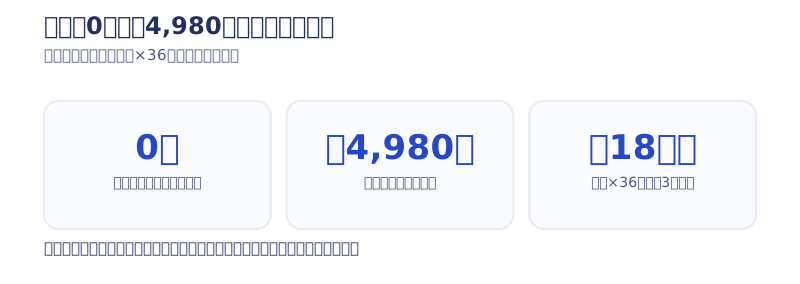
At ¥0 upfront and ¥4,980 a month, that’s about ¥180,000 over three years. If the site disappears on cancellation, add the rebuild cost too. Then ask the salesperson these four questions.
- How many pages can this monthly fee actually build?
- If I cancel, what happens to the site and the domain? How much does it cost to keep them?
- Is the design a template? Please show me three real examples
- What’s included for being found in search and in AI search?
If you get clear, immediate answers to all four, that company is being honest. A subscription contract with them is fine.
How Webharu Builds Sites, and What Happens When You Leave
As a point of comparison, here’s how we do it at Webharu. Judge it on whether it’s true.
- Production starts at ¥1,000,000 (excl. tax). We don’t sell cheap. We start with a meeting for every single company, and implement an acquisition design (SEO, AIO, MEO) tailored to the industry, competitors, and goals
- Our Site Care Plan has no minimum term and no cancellation fee. When you cancel, we hand over the full codebase. The site keeps running as-is after cancellation
- We don’t spend on advertising. Acquisition is entirely through search and AI search — the fact that you reached this article is the demonstration
- We can deliver this quality because we’ve mastered using AI. We rebuilt our own site with AI in seven days and published the whole process
- We build custom systems per client. A mechanism that automatically mirrors Instagram posts into a site’s news section was also built from one client’s request
Which fits you depends on your goal. Getting competing quotes is completely fine — in fact, I’d encourage you to put the four questions to every company and compare. How to run that comparison is in 3 Mistakes SMBs Make When Ordering a Website, and what goes into the annual running cost is in Can a Website Have No Maintenance Cost?.
Even a request to just calculate the total cost of the subscription plan you’re considering is fine. Please reach out via Contact.
Selected work

PonTech Lab Inc.
Built with AI (Claude Code) on Next.js and Cloudflare, with the build process published

Hosted by Nippon TV
High-fidelity Figma-to-Webflow conversion, with load speed and responsiveness optimized

JTB Americas
A full renewal of the North America site, with the operations team able to update it themselves
FAQ
What are the disadvantages of a subscription website?
It costs the most when you leave. Cancellation can bill ¥100,000–300,000 as a retroactive build fee, or charge the remaining contract months as a lump sum — and refusing to pay means losing the site and the URL.
How much am I charged when I cancel a subscription website?
It depends on the contract, but there are two common methods: retroactively billing the waived ¥0 setup fee at ¥100,000–300,000, or billing the remaining contract months as a lump sum. At ¥10,000 a month with 10 months left, that’s ¥100,000.
What is the going rate for monthly website fees?
It depends on what you’re paying for. Subscription types run ¥980 to a few thousand yen a month, WordPress maintenance sits in the ¥10,000–30,000/month range, and Webharu’s Site Care Plan is ¥15,000/month and up (as of October 2026, excl. tax).
Is a ¥980-a-month website a scam?
No — it’s a business model issue, not fraud. Recovering a ¥200,000 production cost at ¥980 a month takes 17 years, so the design recovers it instead through long contracts, cancellation fees, buyouts, and add-on charges.
Do I get the website data when I cancel?
Often not. Quite a few contracts delete the site and charge a buyout fee if you want to keep it. If the provider owns the domain, your search rankings go with it.
What should I check before signing?
Four things: how many pages that monthly fee covers, what happens to the site and domain on cancellation and what it costs, real design examples, and exactly what’s included for search and AI search. Then calculate the total with ‘setup fee + monthly fee × 36 months + cancellation cost.’

![Custom Website vs Web App | Full-Scratch or Full-Stack? [Cost, Timeline, Fit]](/assets/posts/thumb-full-scratch-vs-fullstack.avif?v=2b619e52)
![AI Website Cost: From ¥1,000,000 | Every Deliverable Disclosed [2026]](/assets/posts/thumb-ai-website-cost.avif?v=db2fd782)