![Custom Website vs Web App | Full-Scratch or Full-Stack? [Cost, Timeline, Fit]](/assets/posts/thumb-full-scratch-vs-fullstack.avif?v=2b619e52)
Hello, this is Kurita, Representative Director of Webharu Inc..
The short answer: if you need a site that presents, go full-scratch; if you need a working mechanism beyond the site (members, bookings, payments, a database, an admin screen), go full-stack. At Webharu, full-scratch is from ¥1,000,000 and takes at least 2–3 months, and full-stack (Web Application Development) is from ¥2,500,000 and takes about 2 to 4 months (both excl. tax, as of 2026, starting prices). This article clearly separates the two and explains how to choose.
Key takeaways
- The difference between full-scratch and full-stack — what it means
- Full-scratch is a way of building: designing from zero without templates. Full-stack is a structure: a presenting site that also has members, bookings, payments, a database, and an admin screen. At Webharu, full-scratch is from ¥1,000,000 and takes at least 2–3 months, and full-stack is from ¥2,500,000 and takes about 2 to 4 months (excl. tax, as of 2026).
Contents
The answer: the difference between full-scratch and full-stack is “whether it has a working mechanism”
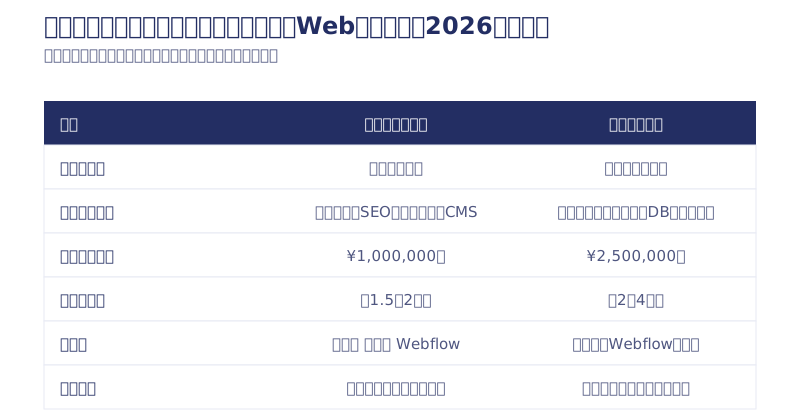
| Point | Full-scratch website | Full-stack website |
|---|---|---|
| What gets built | A site that presents (corporate site, service site, LP) | A site that presents + a working mechanism (a web app) |
| What is included | Design from zero in Figma, SEO/AIO, form and email infrastructure, CMS, analytics, monitoring | Everything on the left + members, bookings, payments, database, admin screen, external API integrations |
| Price (excl. tax, starting) | From ¥1,000,000 | From ¥2,500,000 |
| Typical timeline | At least 2–3 months | About 2 to 4 months |
| Delivery format | Code (Astro / Next.js) or Webflow | Code (not possible with Webflow alone) |
| Deliverables | Full codebase + style guide + AI update guide | Full application + operations documentation |
| Best-fit business | You want to build out or rebuild your brand | You need a mechanism beyond the site, or want to turn it into your own service |
| Detailed article | What is a full-scratch website? | What is a full-stack website? |
The names are similar and easy to confuse, but full-scratch is about “a way of building: designing from zero,” while full-stack is about “a structure that has both a front end and a back end.” At Webharu, full-stack means adding a working mechanism on top of a presenting site built full-scratch.
Do you need full-stack? | 5 questions
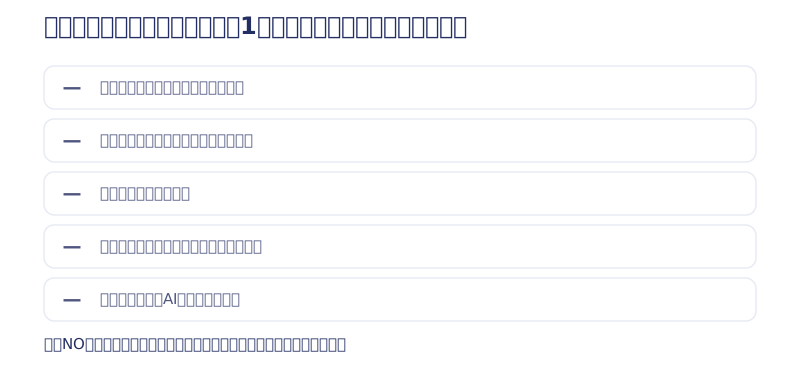
If even one applies, you need full-stack. If all are NO, launch with full-scratch and add features when you need them. Because we deliver in code, adding members or bookings later does not mean rebuilding. Webharu’s own SaaS products (HaruCMS and HaruMail) were built in this order too.
Where AI and Webflow fit | Both are built with AI; only the delivery format differs
Webharu builds both full-scratch and full-stack sites with AI (Claude Code). We don’t say “it’s cheap because it’s AI.” Prices are set by “what we build,” not “what we build it with.” The difference is the delivery format: for full-scratch you can choose code or Webflow (same price). Full-stack has members, payments, and a database, so it is delivered in code. For a comparison of building with Webflow versus building with AI, see the AI chapter of What is Webflow?
Cost and how it’s decided | The final amount is set in requirements definition and does not change after work begins
Both prices above are starting prices. They move with the number of pages, multilingual support, the volume of existing content to migrate, the number of departments involved, security requirements, and whether a photo shoot is needed. We present the final amount with an itemized breakdown after hearing your requirements, and it does not change after work begins. The full picture is on our pricing page.
Selected work

PonTech Lab Inc.
Built with AI (Claude Code) on Next.js and Cloudflare, with the build process published

Hosted by Nippon TV
High-fidelity Figma-to-Webflow conversion, with load speed and responsiveness optimized

JTB Americas
A full renewal of the North America site, with the operations team able to update it themselves
FAQ
What is the difference between full-scratch and full-stack?
Full-scratch is a “way of building”: designing from zero without templates. Full-stack is a “structure”: a presenting site that also has members, bookings, payments, a database, and an admin screen. Which one you need depends on whether you need a working mechanism.
How much does each cost?
At Webharu, full-scratch is from ¥1,000,000 and takes at least 2–3 months, and full-stack (Web Application Development) is from ¥2,500,000 and takes about 2 to 4 months (excl. tax, as of 2026, starting prices). The final amount is set in requirements definition and does not change after work begins.
I can’t decide which one to choose
If you need even one of these five, member login, bookings completed online, payments, managing customer data in-house, or external integrations, go full-stack. If you need none of them, we recommend launching with full-scratch and adding features when you need them. We assess this in a free consultation.
Can a full-scratch site be expanded to full-stack later?
Yes. Because we deliver in code, adding features like members or bookings later does not mean rebuilding. Webharu’s own SaaS products were built in that order too.
Can you deliver in Webflow?
Full-scratch can be delivered in code or in Webflow, at the same price. Full-stack has members, payments, and a database, so it can’t be built with Webflow alone and is delivered in code.

![AI Website Cost: From ¥1,000,000 | Every Deliverable Disclosed [2026]](/assets/posts/thumb-ai-website-cost.avif?v=db2fd782)
