
Hello, this is Kurita, Representative Director of Webharu Inc. We are a company based in Shiogama, Miyagi, Japan, but almost all of our meetings are online: roughly 60–70% of our projects come from across Japan, about 20% from overseas, and about 10% from within Miyagi Prefecture.
The short answer first. A full-scratch website is a site designed from zero without templates and delivered as a full codebase (Astro / Next.js, or Webflow). It is not only about how it looks: it is built as one piece so that people find it in search, enquiries arrive, you can update it in-house, the numbers are visible, it does not break, and you can add to it. Webharu builds these with AI (Claude Code), and pricing starts at ¥1,000,000 (excl. tax) with a timeline of at least 2–3 months (as of October 2026).
Key takeaways
- Full-scratch website — what it means
- A full-scratch website is a website designed from zero without templates and delivered as a full codebase (Astro / Next.js, or Webflow). At Webharu we build SEO, forms and email, a CMS, analytics and monitoring into it as one piece, and deliver it from ¥1,000,000 (excl. tax) in at least 2–3 months (as of October 2026).
Contents
What “full-scratch website” means | Built from zero without templates
“Full scratch” is a term used in Japan for building something from zero, without ready-made templates or systems. For a website, it means designing both the look and the structure specifically for that company, rather than fitting them into an off-the-shelf mold.
That said, what usually appears on a website quote is “design” and “number of pages.” What actually matters after launch, though, is the back of the house: where the form sends to, the settings that keep your email out of the spam folder, the way updates get made, the measurement of traffic and enquiries, and the monitoring that tells you nothing is broken. When a site is designed without templates and all of this is built as one piece, that is what I call a full-scratch website.
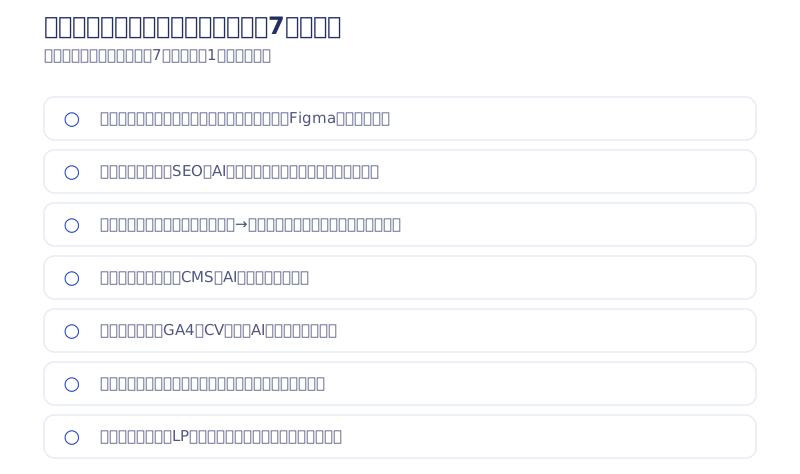
So the visual design is just one of the 7. Put the other way around, a site where only the design is beautiful is usually missing the other 6.
7 things a full-scratch website makes possible
1. A brand you can craft
We do not use templates. We design from zero in Figma, build it with a sturdy BEM structure that resists breaking, and deliver it with a style guide. It is the approach for companies that want to stop looking like a mass-produced template site.
2. Found in search
SEO, AI search readiness and structured data are built in at launch, not added later. Webharu’s own blog has had about 190,000 search impressions over the last 12 months (measured in Search Console).
3. Enquiries never get lost
Form submissions are relayed through our own email infrastructure, and we set up sender domain authentication (SPF, DKIM, DMARC) as well. The point is to eliminate “an enquiry came in, but it landed in spam” from day one.
4. Update it in-house
We deliver a CMS along with a guide for updating the site by instructing AI (the AI update handbook). Your team can run news and the blog in-house, and you can write articles together with AI, so a few posts a month no longer need to be outsourced.
5. Numbers you can see
We set up GA4 plus enquiry and phone-call tracking, and make it possible to see traffic from AI sources such as ChatGPT and Perplexity separately. If you leave operations to us as well, a monthly report covers traffic, search queries, enquiries and AI-referred traffic, and we follow through all the way to fixing what needs fixing.
6. Does not break, does not stop
After launch, automated monitoring runs every day and catches missing redirects or stopped tracking. We check quality with third-party scoring, and our own site scored SSL Labs A+, Mozilla Observatory A+, and Lighthouse 100 (Accessibility, Best Practices, SEO) (as of July 2026).
7. Room to add more
Multiple languages, campaign landing pages and seasonal pages can be added at almost no extra cost. For the Korean version of our own site, we rebuilt what we had been paying a monthly fee per language for on Webflow at ¥0 extra. When you need working systems such as members, bookings or payments, the same codebase can expand into Web Application Development.
What changes when you build full-scratch with AI
What changes is the speed, not the price. We rebuilt Webharu’s own 26-page site with AI (Claude Code) in 3 days of build time, 7 days including planning. The steps are in the article on the 5 stages of building a website with Claude Code.
At the same time, I will not tell you that this makes it cheap. As the 7 points show, what we deliver is not a design but a site ready to grow, along with everything behind it. Because we use AI well, we can deliver this quality. That is why we use AI. The search numbers for AI-built sites are in the article measuring the SEO of an AI-built site.
Full-scratch websites vs. Webflow
I have specialized in Webflow for 6 years, so I know what makes Webflow good: you edit what you see, and it holds together even if you leave it alone. On top of that, from 2026 an approach called vibe coding, where AI writes the code, became usable for real client work, and we can now offer it as an alternative to people considering Webflow. Webharu lets you choose whether the deliverable is code or Webflow, and the price is the same either way.
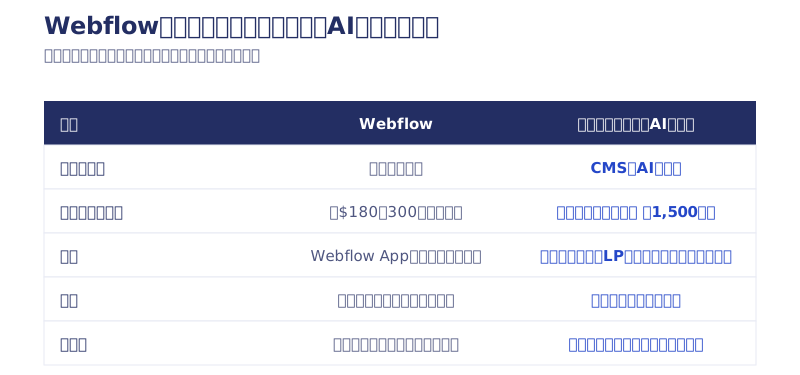
If you do not want to give up visual editing, choose Webflow. If you want to keep running costs low after launch and grow the site by adding languages and landing pages, choose full-scratch delivered as code. Neither one is better than the other. For Webflow itself, see What is Webflow?; for what vibe coding is really like, see the article on doing vibe coding with Claude Code as daily work.
Full-scratch vs. full-stack
Full-scratch means designing and building a site for presenting your business from zero; full-stack means it also includes working systems such as member registration, bookings, payments, a database and an admin panel. At Webharu, a Full-Scratch Website Build starts at ¥1,000,000 and takes at least 2–3 months, and Web Application Development starts at ¥2,500,000 and takes about 2–4 months (both excl. tax, as of October 2026). How to decide which one to build is covered in the article on the difference between full-scratch and full-stack.
Cost and timeline of a full-scratch website | From ¥1,000,000, at least 2–3 months
Webharu’s Full-Scratch Website Build is a guideline of ¥1,000,000 and up (excl. tax) and at least 2–3 months (as of October 2026; this is the starting price). We give you the final amount after hearing your requirements, and we never change the amount once work has started.
Full pricing is on the pricing page, the list of what we actually deliver is in the article on the cost and deliverables of AI website production, and our past projects are in Work. We share more on how we build sites and use AI first in our newsletter (emails are in Japanese), and if you already know the site you want to build, start with a free consultation.
Selected work

PonTech Lab Inc.
Built with AI (Claude Code) on Next.js and Cloudflare, with the build process published

Hosted by Nippon TV
High-fidelity Figma-to-Webflow conversion, with load speed and responsiveness optimized

JTB Americas
A full renewal of the North America site, with the operations team able to update it themselves
FAQ
What is a full-scratch website?
It is a website designed from zero without templates and delivered as a full codebase (Astro or Next.js, or Webflow). At Webharu we build SEO, forms and email, a CMS, analytics and monitoring into it as one piece.
What does “full scratch” mean?
It is a term for building something from zero, without ready-made templates or systems. For a website, it means designing both the look and the structure specifically for that company, rather than fitting them into an off-the-shelf mold.
How much does a full-scratch website cost, and how many months does it take?
At Webharu the guideline is ¥1,000,000 and up (excl. tax) and at least 2–3 months (as of October 2026). We give you the final amount after hearing your requirements, and we do not change it once work has started.
Is it cheaper if it is built with AI?
We do not say “it’s cheap because it’s AI.” What we deliver is not a design but a site that gets found in search, receives enquiries, can be updated in-house and shows its numbers, along with everything behind it. The reason we use AI is that using it well lets us deliver this quality.
Which is better, Webflow or full-scratch?
If you do not want to give up visual editing, Webflow. If you want to keep running costs low after launch and grow by adding languages and landing pages, full-scratch delivered as code. Webharu can also deliver on Webflow, and the price does not change.
What is the difference between full-scratch and full-stack?
Full-scratch means designing and building a site for presenting your business from zero; full-stack means it also includes working systems such as member registration, bookings, payments, a database and an admin panel. At Webharu, full-scratch starts at ¥1,000,000 and full-stack (Web Application Development) starts at ¥2,500,000 (both excl. tax).
![Custom Website vs Web App | Full-Scratch or Full-Stack? [Cost, Timeline, Fit]](/assets/posts/thumb-full-scratch-vs-fullstack.avif?v=2b619e52)
![AI Website Cost: From ¥1,000,000 | Every Deliverable Disclosed [2026]](/assets/posts/thumb-ai-website-cost.avif?v=db2fd782)
