

Hi, I’m Kurita, Representative Director of Webharu Inc.
My answer to “Are websites built with AI bad for SEO?” is no. The weak point isn’t AI — it’s how the site is built. In July 2026 I rebuilt our entire company site with AI (Claude Code), and checked the result against Search Console numbers.
That conventional wisdom was exactly what scared me most about the rebuild. Our blog had been shown in search about 190,000 times over the previous 12 months, and wrecking it would have been no joke. In this article I lay out the evidence, with measured data from the day after launch through September 2026.
Key takeaways
- SEO for sites built with AI — what it means
- SEO for sites built with AI is the question of how search engines evaluate websites produced with AI. Google has stated that it evaluates content by its quality, not by whether it was AI-generated, so what separates the results is how the site is built: URL handover, first-hand experience and human review.
Contents
Why sites built with AI are said to be bad for SEO
In its official guidance, Google states that it evaluates content by its quality, not by whether it was AI-generated. In other words, search engines don’t deduct points simply because AI was used.
I think the myth persists because genuinely weak AI sites really are out there. The three patterns I see most often are listed below.
- AI is told to mass-produce articles with no first-hand experience, so the content could be found anywhere
- Technical groundwork such as the sitemap and structured data is left neglected
- During a redesign, nobody plans how URLs and content will be carried over
Timing matters a lot too. My sense is that AI alone became capable of building production-grade sites only around May–June 2026. Honestly, many services that advertised “cheap because it’s made with AI” before then looked like little more than combinations of templates. I think the fact that those spread first as “AI sites” has reinforced the myth.
If you ordered an AI site purely because it was cheap and it isn’t producing results, take a hard look at what’s actually inside. To put it bluntly, rebuilding it yourself with something like ChatGPT might give you something more valuable. That’s how far the level of today’s AI has risen.
Measurement 1 | The day after the rebuild, 24 of 30 old articles stayed indexed
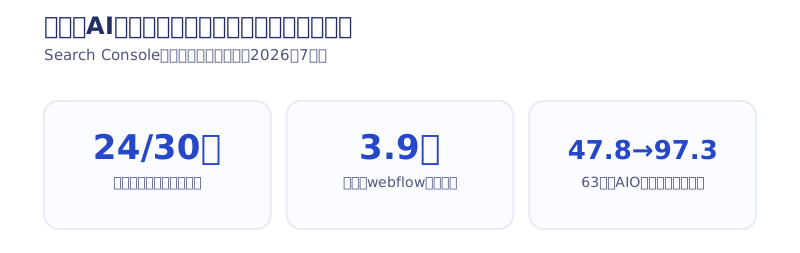
Bottom line: even the day after swapping out the entire system, 80% of our old articles were still in the index. This time we replaced the whole build system, moving from Webflow to Astro.
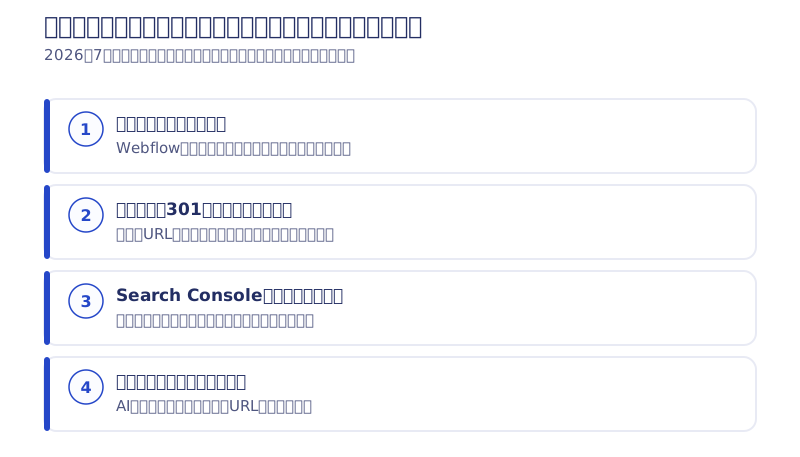
Of the 30 old articles I checked in Search Console the day after the rebuild, 24 remained indexed. Honestly, that number was a relief. The reason is simple: AI handled only the build, while a human designed the SEO handover. We kept every article URL unchanged and made GA4, Search Console, structured data, the sitemap and llms.txt part of the rebuild process. The full process is in my 7-day record of rebuilding our website with AI.
Measurement 2 | Our flagship keyword “webflow” held at around 4th place
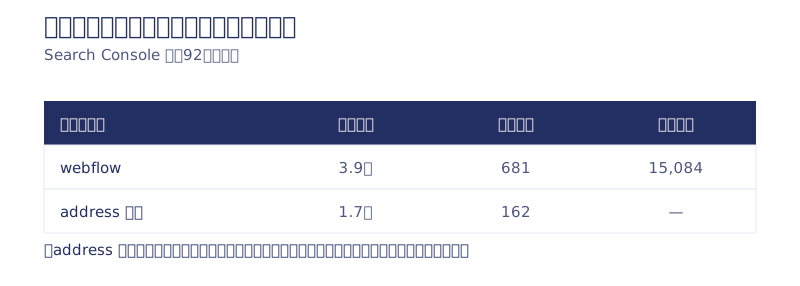
Our blog’s flagship keyword is “webflow.” The measurement I took right after the rebuild, covering the previous 92 days, showed an average position of 3.9, 681 clicks and 15,084 impressions. For the month of September 2026, two and a half months after launch, it was an average position of 4.1, 71 clicks and 4,087 impressions. Even with an AI rebuild in between, the ranking sits in almost the same place.
There’s another interesting data point. One article ranks at an average position of 1.7 with 162 clicks (over the 92 days just after the rebuild) for the search “address 最悪” (“ADDress worst”). It’s an honest review from actually using a housing subscription service, and I didn’t hide the downsides. The article that spells out the downsides holds our strongest keyword. Before the question of AI or not even comes up, what wins in search is first-hand experience and honesty.
AI can’t create first-hand experience. But it’s very good at shaping that experience into a form that reaches search. That’s the next measurement.
Measurement 3 | A bulk implementation across 63 articles that only AI made feasible
In July 2026, we added a format that AI search engines find easy to cite to all 63 articles on our blog in one go. It consisted of the four elements below.
- A key-points box at the top of each article (conclusion first)
- An FAQ section plus FAQPage structured data
- A one-sentence definition of the keyword (“X is …”)
- Speakable structured data
Scored on our in-house criteria before implementation, the 63 articles averaged 47.8 points. After implementation, they averaged 97.3. It’s only our own scoring, so it doesn’t guarantee rankings — the change is that every article now has a structure AI finds easy to cite. Along the way we fixed over 450 typos and merged three pairs of articles that were cannibalizing the same keyword via 301 redirects. Honestly, doing that volume of work by hand just isn’t realistic.
Traffic from AI has started to move as well. AI-referred traffic in GA4 grew from 17 sessions in August 2026 to 61 sessions in September. That said, the number of people using AI is itself growing right now, so we haven’t separated out how much of this is due to the implementation. The implementation design and month-by-month trend are in my article measuring ChatGPT traffic in GA4, and the thinking behind the measures is in LLMO for small and mid-sized businesses.
Measurement 4 | An SEO audit went from a full day’s work to 10 minutes
Having actually run the site, I feel that building with AI is increasingly becoming an advantage for SEO. The reason is speed.
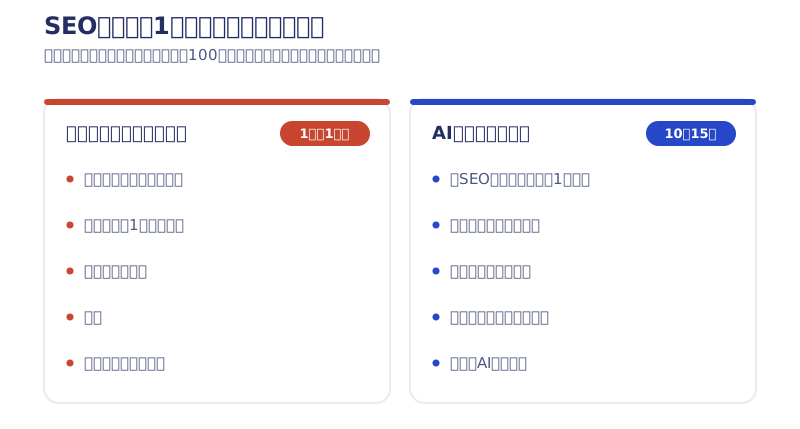
An SEO audit can cover around 100 items on a larger site. AI checks all of them across the board from a single instruction and returns a score as well. It takes 10 or 15 minutes. Back when humans did it alone, the same work took a day or two, and up to a week depending on the scope.
Handling problems after launch is the same. I don’t particularly remember any warnings or errors from Search Console. It’s not that none appeared — the moment one did, I handed it to AI and had it fixed, so none stuck in my memory.
Honestly, so far I haven’t found anything where an AI site with humans in control of design and decisions loses to a site built by humans alone. Of course, that’s within what I’ve seen, and I can’t prove it applies to every site. But this gap in audit speed matters more and more as time goes on.
True story | I almost scrapped our Korean pages, then saved them after looking at the numbers
The old site had a Korean version. It was made with Webflow’s automatic translation, and honestly I expected nothing from it. So during the rebuild I redirected every Korean URL to the Japanese version. I meant to shut it down.
But while looking at Search Console, I noticed the Korean pages I had shut down were still getting clicks. Not many, but not zero. I changed my mind — it felt like a waste — rebuilt the Korean version with AI, and reopened the URLs.
Pages that dropped out of search results during the redirect period didn’t come back right away. Even so, total impressions for the Korean pages have recovered from 2,252 in August 2026 to 3,355 in September. Now that AI handles everything from translation to writing from scratch, I think we can grow the Korean side further.
What I learned is that SEO decisions made on gut feeling are usually wrong. Decisions to scrap something, especially, should wait until you’ve looked at the numbers. The full story of this mishap is in how a site redesign affects SEO.
Ways of building that make a site built with AI weak at SEO
Turn the measurements above inside out, and you can see the conditions under which a site built with AI becomes weak at SEO.
- No handover plan: if you change URLs and don’t set up redirects or a sitemap, your rankings will simply disappear
- Mass production with zero first-hand experience: having AI write “plausible-looking articles” won’t beat a single honest review
- No final human check: text written by AI can contain unexpected wording and numbers
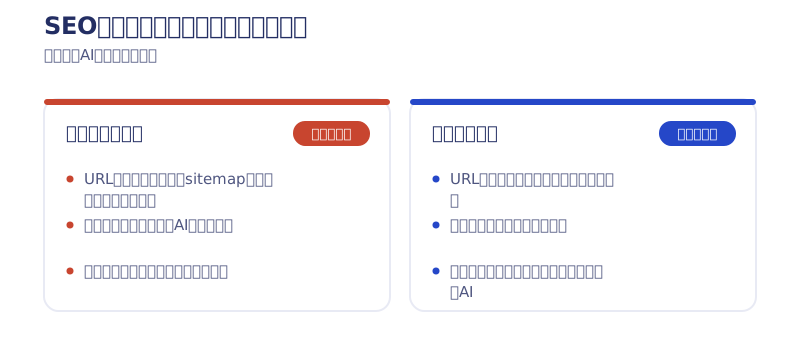
Put the other way around, if humans keep control of decisions and design and hand volume and structuring to AI, AI becomes SEO’s best ally. Technical health is tested separately in my article taking our Ahrefs site audit score from 6 to 98.
Follow-ups to this test go out first in our newsletter (emails are in Japanese). If you want to build or rebuild your own company site with AI, we also offer AI Website Production built on the same design. For inquiries, please use our contact form.
Selected work

New Paint
No.1 in Japan for its local painting keyword 8 days after launch (Search Console)

Hosted by Nippon TV
High-fidelity Figma-to-Webflow conversion, with load speed and responsiveness optimized

PonTech Lab Inc.
Built with AI (Claude Code) on Next.js and Cloudflare, with the build process published
FAQ
Will Google penalize a site built with AI?
Not for being built with AI. Google has officially stated that it evaluates content by its quality, not by whether it was AI-generated. Since rebuilding our own site with AI, we’ve held an average position of 4.1 for “webflow” (September 2026).
Will rebuilding a site with AI lower its search rankings?
It depends on how URLs and content are carried over. We moved our site without changing any article URLs; the day after the rebuild, 24 of 30 old articles stayed indexed, and our flagship keyword ranking didn’t drop.
When does a site built with AI become weak at SEO?
In three cases: when nobody plans the handover of URLs and redirects, when AI mass-produces articles with no first-hand experience, and when no human does a final check of the text AI wrote. All three are problems with how the site is built, not with AI.
How much faster does AI make an SEO audit?
In our case, an audit that took one day to one week by humans alone is finished, including scoring, in 10–15 minutes with AI. The gap comes less from how much you know than from how many times you can run the audit.
What happened to AI-referred traffic after optimizing for AI search?
On our own site it has increased. After adding key-points boxes and FAQ structured data to 63 articles, AI-referred traffic in GA4 went from 17 sessions in August 2026 to 61 sessions in September. The number of AI users is itself growing, so we haven’t separated out how much is due to the optimization.


