

Hi, I’m Kurita, Representative Director of Webharu Inc.. I build websites in Shiogama, Miyagi, Japan.
LLMO for a small business is something you can mostly do yourself, before you ever call in a specialist. Put the conclusion right after the heading. Define your terms in one sentence. Turn your FAQ into structured data. Add an llms.txt file. None of it costs money, and all of it sits on the same line as good SEO.
We’re a company that has acquired every client through SEO and AI search alone, with zero ad spend. This article sorts out the term LLMO, then covers the eight tactics we actually use on our own site, how to write llms.txt, and how to measure the effect.
Key takeaways
- LLMO (generative AI optimization) — what it means
- LLMO is optimization that gets your own information cited or referenced when generative AI such as ChatGPT or Google’s AI Overviews composes an answer. The tactics are mostly an extension of SEO — putting the conclusion first, one-sentence definitions, FAQ structured data, and llms.txt.
Contents
What LLMO Means: Where a Small Business Should Start
LLMO is optimization that gets your own information cited or referenced when generative AI such as ChatGPT composes an answer. It doesn’t replace SEO. There’s no special trick to it — it’s mostly a quiet accumulation of putting the conclusion first, defining terms in one sentence, and structuring the page.
The entry point to search has widened beyond Google to conversations with generative AI. ChatGPT gained a search function, Google’s results now show AI Overviews, and dedicated generative AI search like Perplexity has settled in. If the entry point that leads to an inquiry is shifting from “a list of search results” to “a conversation with AI,” not showing up there is a direct loss of opportunity for a small business.
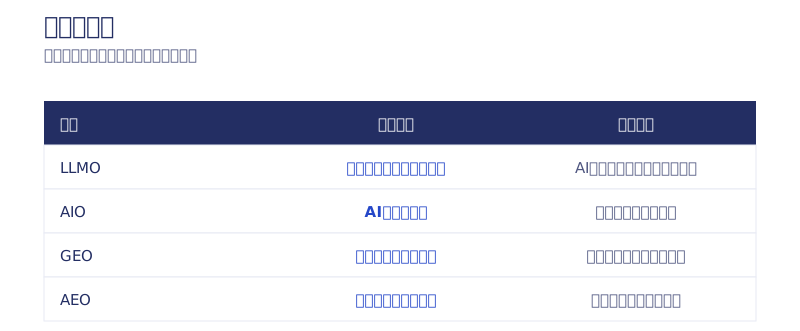
The Difference Between LLMO, AIO, GEO, and AEO
Honestly, there’s still no industry-standard, unified definition for these four terms. The reality is closer to a new market where different companies have each brought in their own label. Here are the broad tendencies.
| Term | What it mainly covers | Notes |
|---|---|---|
| LLMO (Large Language Model Optimization) | Optimization for being cited in LLM-based answers such as ChatGPT, Claude, Perplexity, and AI Overviews | The label most widely used in Japan; this article takes it as its axis |
| AIO (AI Optimization) | Optimization for traffic and citations from AI in general, not just search — including chatbots and recommendation AI | Well known in Japan, often used in a somewhat broader sense |
| GEO (Generative Engine Optimization) | Winning citations in generative AI search engines | The mainstream term overseas; in practice often used as a near-synonym for LLMO |
| AEO (Answer Engine Optimization) | Direct placement in “answer slots” such as featured snippets and voice assistants | Sometimes discussed as a separate role from GEO, though the tactics overlap heavily |
People searching don’t consciously distinguish much between “I’ll look this up in ChatGPT” and “I’ll look this up in Google search.” They just pick whichever window answers fastest, each time. So it’s enough for the people building sites to understand that, labels aside, the shared goal is being chosen by AI as a source. Our own glossary groups “LLMO / GEO” together as generative AI optimization too.
How AI Chooses the Sources It Cites
No company publishes its concrete criteria for choosing sources. What follows is a summary of the publicly documented mechanisms and of what’s generally said to be a tendency, based on observation.
Most generative AI search is described as running on a rough flow of “find candidate pages with a search engine → fetch the content → summarize it into an answer.” Google’s AI Overviews is generally understood to use its own search index, and ChatGPT search and Copilot are generally understood to use mainly Bing-based indexes. In other words, being picked up by a search engine in the first place is, in many cases, the precondition for being picked up by generative AI.
Another point: generative AI usually doesn’t cite a whole page — it often cuts out just one part and uses that in the answer. A supporting sentence buried far from the point it supports is hard to pick up. Writing with the question “would this paragraph still make sense on its own, cut out of context?” in mind is what works in practice.
The characteristics commonly listed for pages that get cited easily are the following five.
- It has a clear one-sentence definition
- The conclusion is written first
- It’s structured with headings, bullet points, and tables
- It has primary information, such as measured data or first-hand experience
- The author or operator is clear, and their track record can be verified
This overlaps almost entirely with E-E-A-T (experience, expertise, authoritativeness, trustworthiness), the thing Google has long emphasized. It’s easiest to understand LLMO as taking what’s always been considered good in SEO and pushing it further.
8 LLMO Tactics a Small Business Can Do Itself
I’ve ordered these starting with what you can begin without any special tool. Because measurement is still difficult in this field, I’ve prioritized what can be done without spending money.
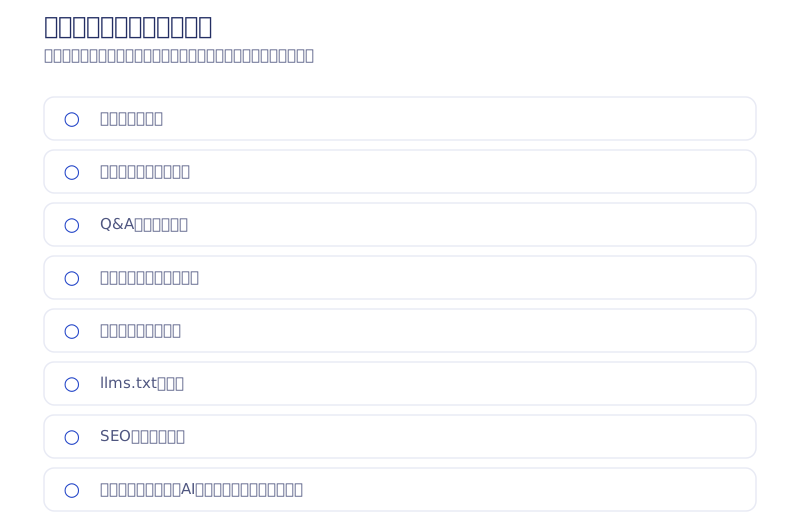
1. Put the Conclusion in One Sentence Right After a Question-Style Heading
When you write a heading in question form — “What is X?”, “What does X cost?” — state the conclusion flatly in the very next sentence. Generative AI is thought to find it easier to use pages where the question and the answer sit close together. Don’t open with background — answer in the first sentence, then follow with the reasons and examples.
2. Prepare a One-Sentence Definition for Each Term
For technical terms and the names of your own services, prepare a one-sentence definition of roughly 60–120 characters in the form “X is Y.” The trick is to place it as an independent sentence rather than burying it inside a longer explanation. On our own blog, each article also carries this one-sentence definition as structured data.
3. Prepare an FAQ and Turn It Into Structured Data
Gather the questions your readers are likely to have, with their answers, into an FAQ, and mark it up with FAQPage structured data (JSON-LD). Because the question and answer become machine-readable as a set, they’re easier to pick up for generative AI and for the answer slots in search results alike.
4. Summarize Key Points in Bullets or a Table
Organizing your key points into bullet points or a table makes it easier for generative AI to extract the information than carrying the explanation entirely in prose. Putting a takeaway box at the top of an article follows the same thinking.
5. Add an llms.txt File
This is a text file that tells AI how your site is organized and which pages matter. I’ll explain how to write one in the next section, using our own file as the example.
6. Make the Author and Operator Clear
Make it clear who wrote the article, who operates the site, and what the track record is. Links to a profile page or a company page, and publishing real names and real results, count. An article whose author’s track record can be verified stands on stronger ground as a basis for citation than an anonymous one with thin support.
7. Register Your Site With Bing Too
Since ChatGPT search is generally understood to use Bing-based indexes, it’s reassuring to register with Bing Webmaster Tools as well as Google. Setup takes less than 10 minutes.
8. Hold Primary Information
Measured data, your own failures, concrete cases — primary information that no copy of another site can produce is the strongest tactic over the long run. When something has to be cited from among several similar articles, the one with original numbers or first-hand experience is more likely to be chosen. The opposite — having AI mass-produce thin articles under the banner of “LLMO” — defeats the purpose. Structuring a page and thinning its content are two completely different things.
How to Write llms.txt: The Structure of webharu.com’s Actual File
llms.txt is a Markdown text file placed at the root of your site. Following the format proposed at llmstxt.org, it tells AI what’s on the site.
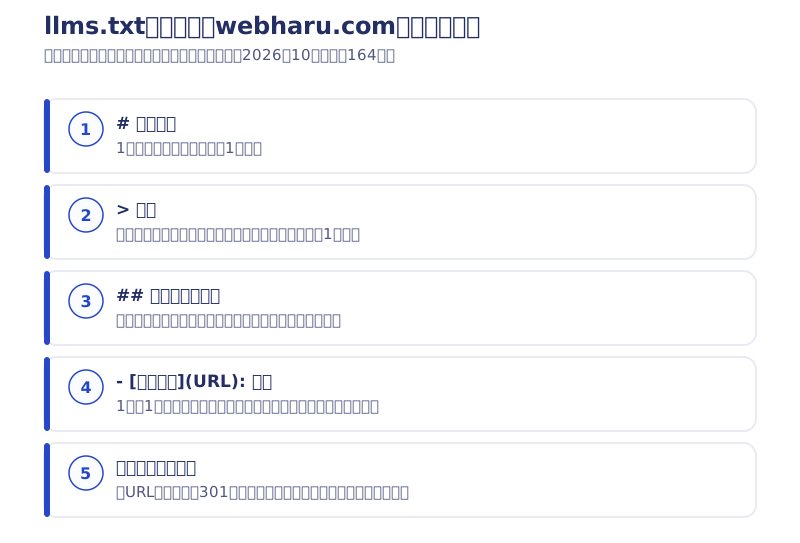
webharu.com’s llms.txt is 164 lines as of October 2026. Here’s how it’s structured.
- Line 1: just the company name, “# Webharu (Webharu Inc. / 株式会社Web春)”
- Second block: one paragraph of summary starting with “>” — what kind of company it is, the location, the main services, and the starting price
- Divided with headings such as “## Services,” “## Our Products,” “## Company,” “## Guides & Tools,” “## Journal,” and “## Work”
- Each line is “- [page name](URL): description.” The description states facts that can double as the answer — price, features, and so on
Two things matter in running this. One is generating it from data rather than writing it by hand — we rebuild our llms.txt during the build every time we add an article or a piece of work. The other is checking it before publishing: we verify by machine that every URL written in llms.txt actually exists and isn’t a 301 redirect source, and we block the deploy if even one fails. If a stale URL or an old price survives in the guide AI reads, AI will answer with that stale information as-is.
Whether llms.txt Works Is Still Unknown
Honestly, llms.txt isn’t a spec any major AI company has officially committed to supporting. I don’t have a number that says traffic grew because of llms.txt alone, either. But the effort to create it is close to zero. The truth is simply that there’s no reason not to add it, so we do.
How to Measure the Effect of LLMO
Measuring the effect of LLMO isn’t as established as SEO measurement. The following three are realistic today.
Look at AI-Referred Traffic in GA4
In GA4, filter “Session source” for traffic from chatgpt.com, perplexity.ai, and the like. On our own site, AI-driven traffic grew from 17 sessions in August 2026 to 61 in September (54 of them ChatGPT). The method and the month-by-month trend are in our article measuring ChatGPT traffic in GA4.
Treat Search Console as an Indirect Clue
Search Console can’t separate impressions via AI Overviews from ordinary search results. Instead, watch whether branded searches for your company or product name are increasing. Someone can learn your name inside an AI answer and come search for it afterward to check.
Ask ChatGPT and Perplexity Directly
The easiest approach is to ask ChatGPT and Perplexity directly about your own product names, service names, and the questions you’re targeting. I recommend fixing three questions related to your business (“recommendations for [region] + [industry],” “reviews of [service name],” “the company name on its own,” for example), asking the same wording every month, and logging in a table whether your company name showed up in the answer. It won’t give you a number, but you can track the direction of change.
Misunderstandings a Small Business Easily Falls Into With LLMO
“Stop Doing SEO and Just Do LLMO” Is Backwards
Most generative AI runs on top of a search engine’s foundation. A site without the SEO basics in place gets limited results from LLMO alone. Ranking well in search carries the same meaning as growing the pool AI can pick you up from.
Adding Structured Data Doesn’t Automatically Get You Cited
Structured data only helps AI understand your content. It’s like handing someone a map — a map can’t bring anyone to a place that has nothing in it.
It’s Not Something You Do Once and Finish
Both the mechanisms behind generative AI and each company’s search algorithms keep changing. Go into this expecting to revisit it regularly.
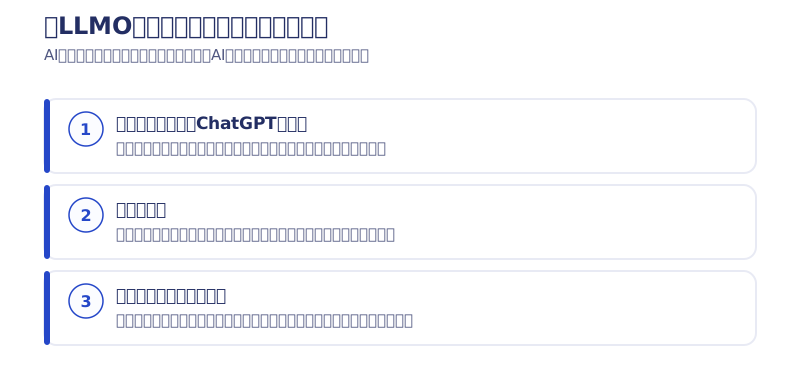
Be Skeptical, at Least Once, of a Firm That Flatly Claims “We Can Do LLMO for You”
It’s a strange thing to say after listing eight tactics, but nobody yet knows what “the right answer” is. So I think it’s worth being skeptical, at least once, of a company that sells on a flat claim. Oddly enough, asking AI about that company’s name often turns up nothing. A company selling ways to get you cited in AI search isn’t itself cited by AI. The way to check is simple: ask ChatGPT about that company’s name.
What We Do: Our Own Site’s LLMO and the Numbers
We Really Do Get Inquiries That Start With “I Looked You Up on ChatGPT”
We’ve actually had someone consult us after saying “I looked you up on ChatGPT.” When I asked, they’d phrased it something like “who’s the best in Japan for Webflow?” People are consulting AI about which company to choose, and real inquiries are coming out of it. That much is definitely happening, as far as I can tell.
Honestly, though, we still can’t systematically measure which queries we get cited for, or how often. AI-driven traffic visible in GA4 is growing, but the cases where our name appeared in an AI answer and simply wasn’t clicked never show up in the numbers. That’s a task still ahead of us.
What We’ve Implemented on Our Own Site
When we rebuilt our own site with AI in July 2026, we built structured data and llms.txt into the standard configuration from the start. The story is in our record of the seven-day AI site rebuild. The same month, we rolled takeaway boxes, FAQs, and one-sentence definitions into all 63 blog articles at once, lifting our own score from an average of 47.8 to 97.3. The full search measurement for the AI-built site is in our article testing whether AI-built sites are weak at SEO.
There Are Things We Haven’t Done
There are things said to work that we haven’t touched yet. One is building up real question-and-answer exchanges on Quora (a Q&A service like the US version of Yahoo! Chiebukuro) or Reddit, which is said to make you easier to cite. I can’t judge myself yet whether it genuinely works.
In the End, Only an Article I’d Want to Read Matters
Our editorial policy is to write short and raise the update frequency. One article a day, five at the very most, feels about right. AI is said to favor newer, more concise writing, so we’re simply going along with that.
Putting out volume isn’t the goal in itself, though. Being readable is a given, but what we weigh heavily beyond that is whether it’s a first-hand account, an actual voice. An article that was merely AI-generated has almost no value, I think.
The reason is simple. I wouldn’t want to read it.
Push the pursuit of getting cited by AI far enough and you end up back at “write an article a person is glad they read.” The word LLMO is new; what you actually have to do isn’t that new. That’s my honest conclusion for now.
Our AI Website Production comes with SEO and AI-search groundwork, including structured data and llms.txt, as standard. If you want to keep adding articles written with LLMO in mind, there’s also our article production service, where our founder edits every piece personally. If you’d like to check whether your own site is in a state to be cited by AI, reach out through the contact form. I publish the next installment of our measurements first in the newsletter.
Selected work

New Paint
No.1 in Japan for its local painting keyword 8 days after launch (Search Console)

Hosted by Nippon TV
High-fidelity Figma-to-Webflow conversion, with load speed and responsiveness optimized

PonTech Lab Inc.
Built with AI (Claude Code) on Next.js and Cloudflare, with the build process published
FAQ
Should a small business hire a vendor for LLMO?
Start with what you can do yourself. Four things cost nothing: writing the conclusion right after a heading, preparing a one-sentence definition for terms, turning your FAQ into structured data, and adding llms.txt. If you do choose a vendor, check by asking ChatGPT about that company’s name and seeing whether it comes up.
Where should I start with LLMO?
Start by writing a one-sentence conclusion right after the headings in your existing articles. Next, add one-sentence definitions for technical terms and service names, then an FAQ with FAQPage structured data. All of them are just additions to articles you already have, at no extra cost.
How do I write llms.txt?
Put the company name on the first line, then one paragraph of summary starting with “>”, then divide it with headings such as “## Services” and list “- [page name](URL): description” one line per page. webharu.com’s llms.txt is 164 lines in this format (as of October 2026).
Does llms.txt actually work?
It’s not yet proven. It isn’t a spec that any major AI company has officially committed to supporting. But the effort to create it is close to zero, so we have it on our own site.
How do I measure the effect of LLMO?
Look at GA4’s “Session source” for traffic from chatgpt.com and similar sources. On our own site, 17 sessions in August 2026 became 61 in September. You can’t measure a citation that wasn’t clicked, so fill the gap with the trend in branded search and by asking AI directly.
What’s the difference between SEO and LLMO?
SEO is about raising your rank in search results; LLMO is about getting cited in a generative AI’s answer. Since most generative AI runs on a search engine’s index, LLMO doesn’t replace SEO — it’s an extension of it.


