
![How to Choose a Webflow Agency: Cost and 5 Quote Checks [From a Rival Founder]](/assets/posts/thumb-webflow-agency-choice.avif?v=4c985a91)
Hi, I’m Kurita, Representative Director of Webharu Inc.. Since 2020 I’ve run a Webflow agency while writing a Webflow blog on the side. It’s a slightly odd article: the side that gets chosen is writing the “how to choose” guide. So instead of a sales pitch, I’ll write from the structure of a quote.
The conclusion first. How you choose a Webflow agency comes down not to the size of the number but to whether you can read these five things out of the quote.
- Who builds it (is the person at the point of contact the same person doing the work?)
- The cost that recurs every year after launch, and who manages it
- CMS design (can you update it yourselves after launch?)
- Handover (can you take the site with you when you part ways with that firm?)
- What’s behind the portfolio (is it still being updated after launch?)
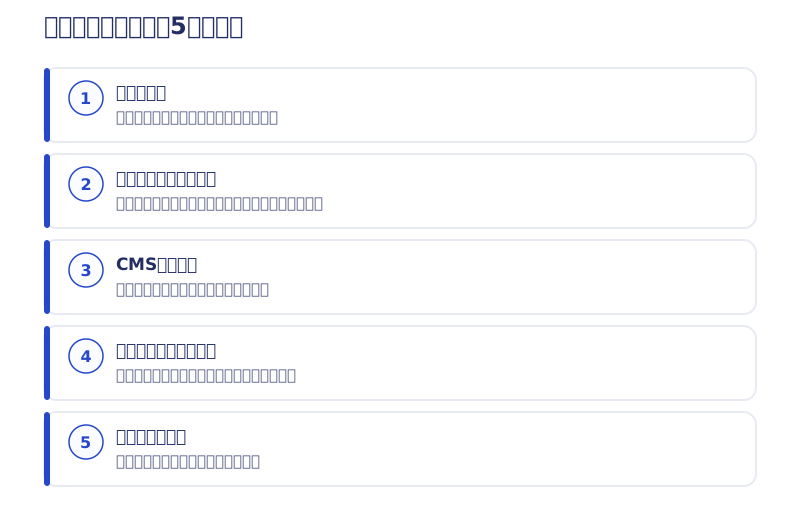
A quote that doesn’t let you read even one of these five will cause trouble after launch, no matter how low the price.
Key takeaways
- Webflow agency — what it means
- A Webflow agency is a production company that takes on the planning, design, building, and post-launch operational support of a website built with the no-code tool Webflow. The cost comes in two parts: the production fee, and the Webflow site-plan cost that recurs every year after launch.
Contents
How to Choose a Webflow Agency, #1: Ask Who Builds It First
The first thing to ask is “who actually does the work?” It’s not unusual in this industry for the firm that wins the contract to hand implementation off to an outside partner or freelancer. Outsourcing itself isn’t wrong, but the more people get added in between, the more intent drifts like a game of telephone, and the slower revisions get.
At Webharu, I build it myself as the founder. The person you talk to in meetings is the person who builds, so “what I said never got through” is unlikely to happen structurally.
How Does a Webflow Build Differ Between an Individual and a Company?
Many people are torn between commissioning an individual freelancer or an agency. The difference shows up less in skill than in the shape of the contract and its continuity.
- Individual: fast, because the person you talk to and the person who builds are the same. On the other hand, maintenance and updates can suddenly stop if their health or business changes
- Company: contracts, invoices, and a point of contact remain with the company. On the other hand, the point of contact and the builder tend to be different people
Webharu is a company, but I’m the one who builds, as the founder. We aim to get both the speed of an individual and the contractual backing of a company. Whichever you choose, it’s reassuring to ask two things: “is the point of contact the same as the builder?” and “who takes over if that person stops?”
The Cost of Commissioning a Webflow Build: Production Fee Plus a Yearly Site Plan
Think of the cost of a Webflow build as two parts: the production fee, and the Webflow site-plan cost that recurs every year after launch. Be careful if a quote leaves out the cost after launch, or glosses over it verbally.
When I was running my own site on Webflow, the site plan — including the Localization (multilingual) feature — came to just under ¥100,000 a year. It can come down depending on configuration, but it’s money that keeps going out every year; building isn’t the end. If a plan is stacked with options you don’t need, a production fee that’s ¥100,000 cheaper gets reversed within a few years. Plan details are in our article on Webflow’s pricing plans, and the real cost including production is in our article on Webflow’s total cost.
For reference, here’s Webharu’s own pricing: a Webflow build runs from ¥1,000,000, and takes at least 2–3 months (as of October 2026, excl. tax). The price is the same whether delivery is in Webflow or exported code. A care plan that hands off updates after launch starts at ¥15,000/month. Details are on the pricing page.
While you’re at it, confirm at the quote stage whether the site plan is billed to you directly or through the agency, and how much update work and maintenance cost per month.
The CMS Design to Check in a Webflow Agency’s Quote
Webflow’s biggest value is that your own team can update the blog and news without writing code. But if the CMS design is sloppy, you end up with a site that needs an agency request for every update, and half the reason you chose Webflow disappears.
At the quote or proposal stage, ask: “which content goes into the CMS, and who’s expected to update it, and how?” A firm that answers specifically — “the blog, news, and portfolio are in the CMS, and your staff can update them from the dashboard” — has designed with life after launch in mind.
I’ve kept updating my own blog myself, and its search impressions have grown to about 190,000 over the last 12 months (measured in Search Console). My honest experience after six years is that the day you build a site isn’t the finish line — a design you can keep updating is what leads to results.

Handover: Can You Part Ways With That Firm?
It’s not a cheerful thing to bring up, but check before you commission anyone what happens to the site when you end the contract with that firm. There are two things to look at.
Ownership of the Webflow Project
Can they place the project in your own Webflow account (workspace)? If it stays in the agency’s account, you can’t take the site with you once the relationship ends.
How Code Export Is Handled
Webflow has a feature to export code, but as a general rule, parts like the CMS and forms stop working in the exported code. Supported plans and specs change, so ask before signing — “what happens if we need a handover?” — and check it against Webflow’s latest official information.
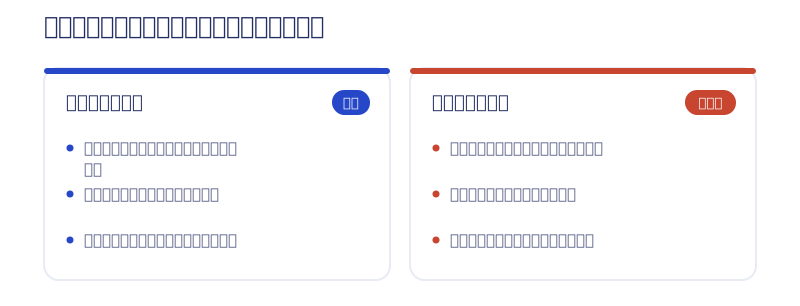
The more honest a firm is, the more it answers this question without flinching. If the answer is vague, the setup may be built around locking you in.
Judge a Portfolio by Whether It’s Still Running After Launch, Not by Looks
Of course the screenshots on a portfolio page look clean. What you should check is what happened to that site after launch. Open the portfolio sites yourself and look at the last-updated date on the news or blog. That’s where you’ll find out whether the CMS is still actually being used.
Webharu publishes every piece of our own work on our portfolio page, including sites for JTB Americas and an event hosted by Nippon TV, as well as a project migrating over 100 articles from WordPress to Webflow (the process is in our article on migrating from WordPress to Webflow). But more than the names in a portfolio, what I’d want you to look at is the agency’s own site and blog. That’s the place where its design thinking and operational strength show up most honestly. If a candidate firm’s own blog has sat frozen for years, I think it’s hard to expect the kind of design that keeps getting updated.
Ask About the Design Process Too
If the design phase in a quote says “build a complete design comp in Figma, then reproduce it in Webflow,” that work adds up fast. I almost never use a plugin like Figma to Webflow on real projects — my standard is to reach agreement on the look in Figma, then build it directly in Webflow. Asking why a firm runs it the way it does reveals a lot about its skill (how to copy a design from Figma into Webflow).
5 Questions to Ask Before You Commission a Webflow Build
Once you have a quote, try asking these five questions as they are.
- Who actually does the building? (Is it the same person as my point of contact?)
- What’s the total cost that recurs every year after launch?
- After launch, which content is designed for us to update ourselves?
- If we end the contract, what happens to the site’s ownership and data?
- Among your portfolio sites, can you show me examples still being updated after launch?
A firm that answers all five specifically is one you can use not just to build Webflow and walk away, but to operate it and get results. If Webflow itself is new to you, start with what Webflow is, what it costs, what it can do, and how to choose an agency; if you’re torn between Webflow and STUDIO, start with our comparison of Webflow and STUDIO.
If you’d like to include Webharu as one of the firms in your quote comparison, reach out through the contact form. Feel free to throw these five questions straight at me. What a Webflow build with us covers is summarized on our Webflow website production page.
Selected work

JTB Americas
A full renewal of the North America site, with the operations team able to update it themselves

Hosted by Nippon TV
High-fidelity Figma-to-Webflow conversion, with load speed and responsiveness optimized

PonTech Lab Inc.
Built with AI (Claude Code) on Next.js and Cloudflare, with the build process published
FAQ
What matters most in how you choose a Webflow agency?
Not the price, but whether a quote lets you read five things: who builds it, the yearly site-plan cost, CMS design, handover, and what’s behind the portfolio. A firm that can answer all five specifically has designed with life after launch in mind.
How much does it cost to commission a Webflow build?
Two parts: the production fee, and the site-plan cost that recurs every year after launch. At Webharu, a Webflow build runs from ¥1,000,000 and takes at least 2–3 months (as of October 2026, excl. tax). The site-plan cost on our own site, including Localization, came to just under ¥100,000 a year.
Should I commission an individual or a company for a Webflow build?
The difference is less about skill than the shape of the contract and its continuity. An individual is fast because the person you talk to and the person who builds are the same, but maintenance stops if that person stops. Either way, confirm whether the point of contact is the same as the builder, and who takes over if that person stops.
Can a site built in Webflow be handed over to another firm?
Yes, as long as project ownership sits in your own Webflow workspace. Exported code generally has parts like the CMS and forms stop working, so ask before signing how handover is handled.
How many Webflow agencies should I get quotes from?
What matters is substance, not the number of firms. Give the same brief to every firm, then line up their answers to the five questions and the total yearly cost after launch side by side.

![Webflow vs STUDIO: Pricing, CMS, and Which to Choose [2026]](/assets/posts/thumb-webflow-vs-studio.avif?v=7e977456)
![WordPress to Webflow Migration | How We Moved 100+ Articles, and When to Quit [2026]](/assets/posts/thumb-wordpress-not-recommended.avif?v=975b3637)