
Hi, I’m Kurita, Representative Director of Webharu Inc. I build HaruCMS, a Japan-made headless CMS.
The short answer first: microCMS’s free plan (the Hobby plan) caps data transfer at 20GB a month. Go over, and the API stops — your site’s article area goes blank. API request count is unlimited, so the only thing to watch on the free plan is transfer volume.
Every number here was checked directly on microCMS’s official pricing page on October 2, 2026. The pricing page itself states these are “the latest pricing plans, revised on 2025/6/10.”
※ Note: this comparison includes HaruCMS, which we develop and operate. Read it with that in mind. All figures for other companies come from public information on each company’s official pages.
Key takeaways
- microCMS’s free plan — what it means
- microCMS’s free plan means the ceiling available on the Hobby plan (¥0/month): 20GB of monthly data transfer, 5 APIs, 3 members, and 10,000 items (confirmed on the official pricing page, October 2, 2026). API request count is unlimited, but once data transfer exceeds 20GB, the API stops.
Contents
Inside microCMS’s free plan (the Hobby plan)
In short, the limits are as follows — and in production, the one that actually bites is the 20GB of data transfer.
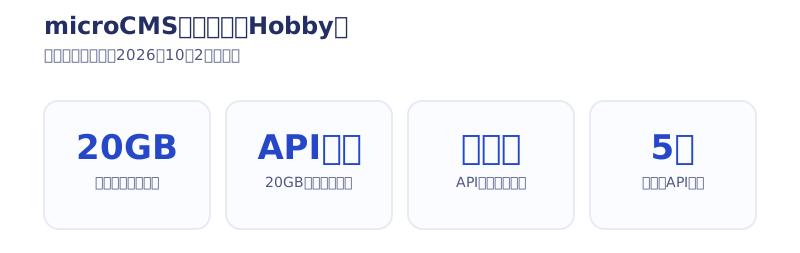
| Item | microCMS Free Plan (Hobby) |
|---|---|
| Monthly fee | ¥0 |
| Data transfer | 20GB/month (API stops if exceeded) |
| API requests | Unlimited |
| Number of APIs | Up to 5 |
| Members | Up to 3 |
| Content items | 10,000 |
| Media capacity | Unlimited (up to 40MB per file) |
The 5 APIs are the number of content types — things like “blog,” “news,” and “categories.” For a small corporate site, 5 is often enough, but on sites with more content types, you’ll hit the API-count ceiling before the transfer one.
Exceed microCMS’s free plan and the API stops
The official pricing page states: “If you exceed the prescribed data transfer amount, you will no longer be able to use the API.” You can’t fetch articles until you upgrade your plan or the next month arrives.
Data transfer is the volume of API responses (your article data) and images sent from the CMS’s servers to your readers’ browsers. On an image-heavy site, you can reach 20GB at just tens of thousands of monthly pageviews. If your site “might occasionally go viral” or has traffic you can’t predict, choose while picturing what actually happens when it stops.
Paid Team plans and above don’t stop. Anything over the limit continues on metered billing per GB.
microCMS pricing (after the June 2025 revision, excl. tax)
| Plan | Monthly fee | Data transfer | Overage | APIs | Members |
|---|---|---|---|---|---|
| Hobby | ¥0 | 20GB | API stops | 5 | 3 |
| Team | From ¥4,900 | 200GB | ¥20/GB | 10 | 3 |
| Business | From ¥75,000 | 1TB | ¥18/GB | 30 | 20 |
| Enterprise | By quote | — | — | — | — |
Team and Business both have add-on options: ¥1,200/month per extra member, and ¥2,000/month per extra API (confirmed October 2, 2026).
The step above Team is ¥75,000
Looking at the pricing table, after ¥4,900 a month the next tier is ¥75,000 a month. If ¥4,900 isn’t enough but ¥75,000 is out of reach, you’ll end up inching up by adding members or APIs one at a time. It’s safer to choose your entry plan with an eye not just on your current scale, but on what the next tier costs once your site grows.
More sites, more contracts
This is what hits production agencies, freelancers, and companies running multiple brands hardest. microCMS’s official help states that when an agency deploys it per client, a new service contract per client is the rule (confirmed August 2026; bundling multiple services into one contract is Enterprise only). Ten projects means ten Team contracts, at roughly ¥49,000 a month.
Headless CMS pricing compared: microCMS, NILTO, HaruCMS
Beyond microCMS, here is how other Japan-made headless CMS services compare on how their free plan stops and where the paid tier begins.
| Service | Free-plan ceiling | Paid entry point | What you’re billed on |
|---|---|---|---|
| microCMS | 20GB transfer/month; API stops if exceeded | From ¥4,900/month (Team, excl. tax) | Transfer, API count, member count. Contracted per site |
| NILTO | 100,000 requests/month; restricted if exceeded | ¥19,800/month (Starter) | Request count, number of spaces. Transfer is unlimited on every plan |
| Craft Cross CMS | No free plan | From ¥40,000/month | Newt’s successor, enterprise-oriented (as of August 2026) |
| HaruCMS | 1 site, unlimited articles, never stopped by transfer | ¥980/month (Solo, tax incl.) | Number of sites, members, storage. Transfer isn’t billed |
I checked NILTO’s official pricing page on October 2, 2026. Paid tiers are Starter ¥19,800, Team ¥49,800, and Business ¥98,000; paid plans don’t stop even past the request ceiling, continuing at ¥5 per 1,000 requests.
HaruCMS runs Solo at ¥980/month (3 sites, custom-domain delivery), Studio at ¥2,980/month (unlimited sites and members), and Business at ¥9,800/month (tax incl.). API requests have a fair-use guideline, but going over it doesn’t stop you — it continues at ¥100 per 1,000,000 requests. The free plan delivers on a shared domain (~.harucms.app); custom-domain delivery starts from Solo.
A comparison table covering more services is at our Japan-made headless CMS comparison.
On a static site, the only thing your free plan has to worry about is image transfer
Before you get an estimate, check how your own site is built. A site built with static generation (SSG) in Astro or Next.js calls the API only at build time. However many tens of thousands of readers show up, requests to the CMS do not increase.
With that architecture, you can effectively ignore the API request ceiling — the only thing that matters is image transfer volume. Conversely, an architecture that calls the API on every view — SSR, or fetching from the browser — grows both requests and transfer in proportion to pageviews. Before you look at a pricing table, confirm which of the two your own site is. That is the surest first step toward an estimate.
How to choose by scale
- Personal blogs, small sites (up to 10,000 pageviews/month): any free plan will get you through. If you have a lot of images, just keep an eye on microCMS’s 20GB
- A single corporate site: microCMS Team (from ¥4,900/month, excl. tax) or HaruCMS Solo/Studio (¥980–2,980/month, tax incl.). If transfer is likely to grow, lean toward the side that doesn’t stop
- Media sites, high-traffic sites: metered transfer billing makes costs hard to predict, so compare — on measured numbers — either a structure that doesn’t bill on transfer, or a plan with a high ceiling
- Production agencies, multiple sites: HaruCMS Studio (¥2,980/month, tax incl.), with unlimited sites, keeps the monthly fee the same even as projects increase
- Large enterprises: choose on SLA, permission management, and support structure — microCMS Enterprise, Craft Cross CMS, or HaruCMS Business (¥9,800/month, invoice payment supported)
Further reading
- Before migrating from Newt to microCMS, compare these 4 alternatives
- A step-by-step guide to migrating from Newt to HaruCMS
- HaruCMS (from ¥980/month — Studio gives you unlimited sites on one contract)
The first 100 people who start using HaruCMS get Solo or Studio at half price for life (open until either 100 sign-ups or November 24, 2026, whichever comes first).
If you’re a developer building your own headless CMS or API, our newsletter is worth a look too — I write about what goes on behind the scenes of building our own CMS and email API.
Selected work

CRM Support Center
Added pages, automatic tables of contents and CMS categories without stopping operations

Hosted by Nippon TV
High-fidelity Figma-to-Webflow conversion, with load speed and responsiveness optimized

PonTech Lab Inc.
Built with AI (Claude Code) on Next.js and Cloudflare, with the build process published
FAQ
How far does microCMS’s free plan go?
On the Hobby plan (¥0/month) you get 20GB of monthly data transfer, 5 APIs, 3 members, 10,000 items, and unlimited media capacity (up to 40MB per file). API request count is unlimited (confirmed on the official pricing page, October 2, 2026).
What happens when you exceed microCMS’s free plan?
Once monthly data transfer exceeds 20GB, the API stops working. You either upgrade your plan or wait until next month — until then, you can’t fetch articles, and your site’s article area goes blank. Paid plans from Team up don’t stop; the excess is billed at ¥20 per GB (Team).
Has microCMS’s pricing been revised?
Yes. The official pricing page states the plans were revised on June 10, 2025, and as of October 2026 they stand at Hobby ¥0, Team from ¥4,900, Business from ¥75,000 (excl. tax), and Enterprise by quote.
Can I run a commercial site on microCMS’s free plan?
You can, but plan for it to stop. On a commercial site with unpredictable traffic, the API stops the moment you exceed 20GB of transfer. It’s safer to choose a plan designed not to stop, or to assume a paid plan from the start.
What is the going rate for a headless CMS?
Among Japan-made services, the paid entry point ranges from ¥980/month (HaruCMS Solo, tax incl.) to ¥19,800/month (NILTO Starter). Plans built for serious production use run ¥40,000–98,000/month (as of October 2026). Realistically, budget ¥1,000–5,000/month for individuals and small sites, and ¥20,000 or more a month for full corporate use.
Wouldn’t an overseas headless CMS (Contentful, Sanity, Strapi) be cheaper?
Their free tiers are generous, but the metered calculations are complex and exposed to the yen’s exchange rate. Running Strapi on your own server means the labor of server operation, updates, and backups becomes the real cost. If your content editors aren’t engineers, a Japan-made flat-rate plan usually gives you a more predictable total.

![Custom Website vs Web App | Full-Scratch or Full-Stack? [Cost, Timeline, Fit]](/assets/posts/thumb-full-scratch-vs-fullstack.avif?v=2b619e52)
