

I’m Kurita, Representative Director of Webharu Inc. From Shiogama, Miyagi, Japan, we build websites and our own SaaS products.
The conclusion first. MCP server development can be outsourced. On cost: putting the same requirements to a large Japanese systems integrator (SIer) typically runs ¥5,000,000–¥12,000,000 in total even at small scale (per SIA Inc., as of 2026). We take it on at ¥2,500,000 for a read-only MCP Starter and ¥5,000,000 for an API + MCP Full Pack (both excl. tax).
I have implemented MCP servers on two of our own SaaS products (HaruCMS and HaruMail) and run them in production. As someone who builds and operates them, I’ll lay out the market rates and the “five things to ask before you commission.”
This is written for CTOs, engineering leads, and IT managers at companies already running a SaaS or business system. “We’ve been told to make our SaaS MCP-ready.” “We want AI to work with our internal systems, but an accident would be frightening.” If either of those describes you, this should be useful all the way to the end.
Key takeaways
- MCP server development — what it means
- MCP server development means building the connection point that lets AI operate your own systems and data directly. In Japan, the outsourcing benchmark from the adjacent field of API integration development runs from ¥1,000,000 to over ¥10,000,000 (per GXO Inc., as of 2026). We build them at ¥2,500,000 for a read-only MCP Starter and ¥5,000,000 for an API + MCP Full Pack (both excl. tax).
Contents
What an MCP server is: the connection point that lets AI operate your systems
An MCP server is a connection point that lets AI such as Claude or ChatGPT operate your own systems and data directly.
Because it is built to a common standard called MCP (Model Context Protocol), it isn’t tied to one particular AI. Any AI client that supports MCP can use it.
As the buyer, you only need to grasp one point. AI use without an MCP server means “a person looks at screens and copy-pastes as the intermediary”; AI use with one means “AI operates your systems directly.” What separates companies whose AI stops at summarizing meeting notes from companies where AI runs real work is, in most cases, whether this connection point exists.
What MCP server development makes possible
All three are setups I have actually built and run.
Updating your CMS or business systems from AI
Ask the AI to “turn last week’s trade show report into an article and leave it as a draft,” and the AI creates the article directly in the CMS. HaruCMS implements an MCP server (8 tools), so creating and updating articles and even uploading images can be driven from AI. Any system where people currently type data in through screens — inventory, customer management — can be built the same way.
Handing email sending and receiving to AI
The AI reads incoming mail, sorts it, and even drafts the replies. HaruMail lets AI handle both sending and receiving through its MCP server. The key is protection against mis-sends: every sending tool stops at creating a draft. The actual send only runs through a separate tool called confirm_send. What the AI is trusted with and what a person keeps in hand are separated by design.
Starting with just letting AI read internal data
When companies want AI to see internal documents or databases, most of them currently paste into a chat window. Build a single read-only MCP server, and the AI fetches the data it needs, in the amount it needs, by itself. It can be configured to allow no writes at all, which makes it well suited to starting small.
MCP server development cost (as of 2026)
A premise first. As of 2026, MCP server development has no established market rate yet. In my research in August 2026, effectively only 4 companies in Japan offered MCP server development as a product page, and only 1 published its price. So below, with sources, I set out the Japanese rates for the adjacent field of API integration development alongside the rates for MCP development in the US, which is further ahead.
Japan: ¥1,000,000 to over ¥10,000,000 for API integration development
- Single API connection ¥300,000–¥1,000,000, multiple API integration ¥1,000,000–¥3,000,000, business-flow integration ¥3,000,000–¥6,000,000, API-enabling a core system ¥6,000,000 to over ¥10,000,000 (GXO Inc.’s market-rate guide)
- Contract development for large enterprises actually runs ¥1,000,000–¥1,800,000 per person-month, and ¥5,000,000–¥12,000,000 in total even at small scale (SIA Inc.)
- Typical person-month rates are ¥800,000–¥1,200,000 at small and mid-sized developers and ¥1,500,000–¥2,000,000 at large SIers (CREX / Cross Network)
US: enterprise-grade MCP runs over $100K
- MCP server development runs $18K–50K for an MVP and $110K to over $400K at enterprise grade (Bacancy)
- MCP integration for SaaS runs $10K–50K for a basic setup and over $100K for an enterprise setup (Intuz)
- A marketplace-grade MCP server runs $100K–300K read-only and $300K–700K with write access (Launch Day Advisors)
Maintenance typically runs ¥120,000–¥330,000 per month, and keeping up with API specification changes costs ¥100,000–¥300,000 each time (GXO Inc.).
Our pricing: Starter ¥2,500,000 / Full Pack ¥5,000,000
As of October 2026, all excl. tax.
- MCP Starter (read-only) ¥2,500,000: puts a read-only MCP layer over your existing REST API. With no writes, it is an entry point where the path to an accident doesn’t exist structurally. About 4–6 weeks
- API + MCP Full Pack ¥5,000,000: the complete set, from REST API design to authentication (separate pk/sk keys, revoked instantly on suspension), rate limiting, audit logs, two-stage confirmation for risky operations, the MCP server, developer documentation, and llms.txt
- Full Integration from ¥10,000,000: opening up writes, multiple AI clients, integration per business system. Quoted individually
Ongoing operation and maintenance is from ¥150,000/month (keeping up with API specification changes, monitoring, key management).
Here is where that sits against the market. Put the same requirements to a large SIer and over ¥10,000,000 is the norm. We have built this same setup on two of our own SaaS products and run it in production, so the design pattern already exists. We factored that in and set the Full Pack at ¥5,000,000. Please choose us not for the price but because “the pattern is already running in production.”
Compare quotes on whether these 4 are included, not on price
When reviewing a quote for MCP server development, check whether the following four items are included.
- Authentication: managing who can use it with keys. Does it cover the design of key issuance and revocation?
- Rate limiting: keeping the system from going down under a runaway AI or excessive outside access
- Audit logs: a full record of when, which key, and what was done. The foundation for incident investigation and internal control
- Documentation: a specification both people and AI can read. An asset for keeping it in use in-house after rollout
A working MCP server on its own can be built for much less. But put it into business use without those four, and shortfalls erupt once you are in operation — a departed employee’s key stays alive, or you can’t trace the cause of an accident. Pricing and process details are on the API + MCP development pricing page.
Five things to ask before outsourcing MCP server development
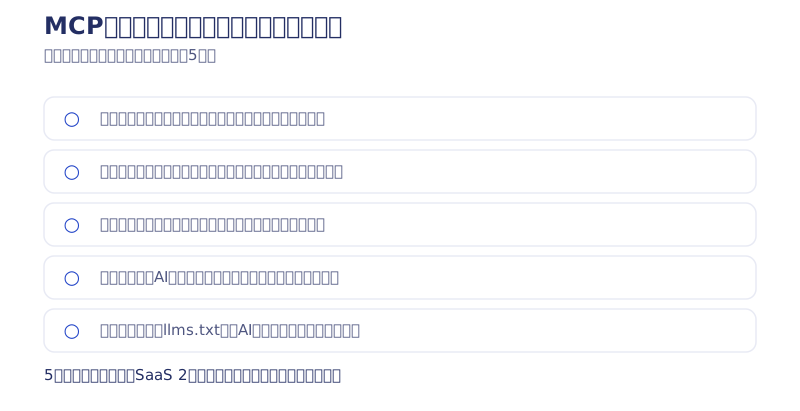
The five items below are what I most want you to take away from this article. Ask them as-is when you get quotes from development companies. I confirmed every one of them as “trouble without it” while running our own SaaS in production.
(1) Key revocation: do a departed employee’s keys stop?
Ask: “When the person in charge leaves or changes roles, what happens to the API keys they issued?” If the design keeps issued keys alive even after the login is disabled, a person who has left can still write from outside. In HaruCMS, suspending a member automatically stops the keys that person issued.
(2) Preventing mistakes: by prompt, or by structure?
Ask: “Is the mechanism that keeps AI from accidentally mass-sending email or deleting data based on prompts, or on structure?” “We instruct the AI carefully, so it’s fine” is not an answer. HaruMail doesn’t offer a one-shot sending tool at all; sending only runs through two stages, draft creation → confirm_send.
(3) Audit logs: is every operation recorded?
Ask: “Can we trace afterward when, which key, and what was done — all of it?” AI operations are numerous and fast, so without a record you can’t trace the cause when an accident happens. We record every write operation in our own products in audit logs.
(4) Tool design: does it eat up the AI’s context?
This is a bit technical, but it is the item that most affects usability. AI has an upper limit on how much information it can handle at once (its context), and an MCP server with too many tools or overly large responses fills the AI’s capacity just by being connected.
I made exactly this mistake with a general-purpose MCP for an external SaaS (Webflow MCP 1.0). Just connecting it loaded a huge amount of information, filled most of the context, and it never reached practical use (details in my article trying Webflow MCP). Since then I have been strict about limiting the number of tools and keeping responses small. Try asking: “How will you limit the number of tools and the amount of information returned?”
(5) Documentation: is it delivered in a form AI can read?
Ask: “Will the delivered documentation include an AI-readable format (such as llms.txt)?” These days, AI agents themselves handle MCP server rollout and in-house deployment. With an AI-readable specification, connecting is done just by having the adopting side’s AI read it. HaruCMS publishes its developer documentation and llms.txt openly.
Our track record: MCP servers in production on two of our own SaaS products
This isn’t “we can build it” but “we built it, sell it, and run it.”
- HaruCMS (headless CMS, launched August 2026): implements a REST API + MCP server (8 tools), with developer documentation and llms.txt published openly. Keys are split into pk and sk, and suspending a member automatically stops that person’s keys. Every write operation goes to the audit log
- HaruMail (email sending/receiving API, launched August 2026): an email API usable in Japanese + MCP server. Actual sending runs in two stages via confirm_send, structurally preventing AI mis-sends
We have also put an admin MCP into our own operations platform (writes only within a safe allowlist, every operation recorded in audit logs) and use it in-house every day. I wrote up all the design decisions in the article on five patterns for making a SaaS MCP-ready — material for your technical staff to scrutinize.
Three steps from request to delivery
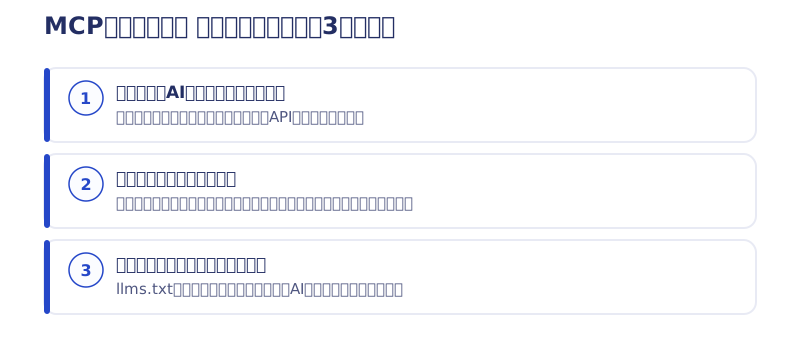
Step 1: Decide in a free consultation whether it can be handed to AI
We hear what you want to do and judge whether that work can — and should — be handed to AI. A consultation just for that judgment is fine. The architecture and cost change depending on whether your existing system has an API, so we check your current setup here too.
Step 2: Settle the safety design, then implement
We decide the scope of key permissions, the protection against mistaken operations, and the audit log design first, then build. We don’t build something that works first and bolt on safety afterward.
Step 3: Deliver through documentation and confirm it runs from AI
We deliver documentation for people and AI-readable documentation (llms.txt), and confirm together that it actually runs from the AI clients you use (Claude, ChatGPT, etc.).
Summary: commission MCP server development together with its safety design
The key to outsourcing MCP server development without failure is to commission not “something that works” but “a complete set you can run safely.” Key revocation, two-stage protection against mistaken operations, audit logs, tool design, and AI-readable documentation. These five items work as-is as questions for any development company.
We welcome even just the question “Could this work of ours be handed to AI?” See the API & MCP development service details, or send it through the free consultation form.
Related: Five patterns for making a SaaS MCP-ready / Connecting AI agents to existing systems. Developers building MCP or APIs themselves may also like our newsletter (emails are in Japanese), where I continue writing about developing our own SaaS.
Selected work

PonTech Lab Inc.
Built with AI (Claude Code) on Next.js and Cloudflare, with the build process published

Hosted by Nippon TV
High-fidelity Figma-to-Webflow conversion, with load speed and responsiveness optimized

JTB Americas
A full renewal of the North America site, with the operations team able to update it themselves
FAQ
What does MCP server development cost?
As of 2026, the adjacent field in Japan (API integration development) runs ¥300,000–¥1,000,000 for a single API connection, ¥1,000,000–¥3,000,000 for multiple API integration, and ¥6,000,000 to over ¥10,000,000 for API-enabling a core system (per GXO Inc.), and contract work for large enterprises totals ¥5,000,000–¥12,000,000 even at small scale (per SIA Inc.). In the US, enterprise-grade MCP development runs $110K to over $400K (per Bacancy).
How much does it cost to commission Webharu?
MCP Starter (read-only) ¥2,500,000, API + MCP Full Pack ¥5,000,000, and Full Integration from ¥10,000,000 (all excl. tax, as of October 2026). Ongoing operation and maintenance is from ¥150,000/month.
How long does development take?
The Starter, which puts a read-only MCP layer over your existing REST API, takes about 4–6 weeks. The Full Pack and above, which start from building the API, add a design phase, so the timeline depends on requirements. We hear about your current setup in a free consultation and give a timeline together with the quote.
How should we choose an MCP server development company?
Choose on five items: (1) do a departed employee’s keys stop automatically, (2) are mistaken operations prevented by structure rather than prompts, (3) is every operation kept in audit logs, (4) do they limit the number of tools and the amount of information returned, and (5) do they deliver AI-readable documentation (such as llms.txt)? If all five are “yes,” you can trust them with the work.
Can we start small?
Yes. We recommend the read-only MCP Starter (¥2,500,000 excl. tax, about 4–6 weeks). It has no write permissions at all, so you can verify the benefits with no path to an accident.
Can we commission just an API or CLI rather than MCP?
Yes. We combine REST APIs, CLI tools, and MCP servers to fit your requirements. We have also built, in-house, a way to call AI from local apps and internal tools without an API key (a Claude CLI local bridge), and used it on real projects.


![Custom Website vs Web App | Full-Scratch or Full-Stack? [Cost, Timeline, Fit]](/assets/posts/thumb-full-scratch-vs-fullstack.avif?v=2b619e52)