


- Full-stack website — what it means
- A full-stack website is a site that holds not only the front end that presents but the working mechanism behind it — member sign-up, bookings, payments, a database, an admin screen and external API integrations — as one piece. Webharu offers it as Web Application Development from ¥2,500,000 (excl. tax) in about 2 to 4 months, built the way we run our own SaaS products (HaruCMS and HaruMail) in production.
Hello, this is Masato from Webharu.
A full-stack website is a site that holds not only the front end that presents, but the working mechanism behind it — member sign-up, bookings, payments, a database, an admin screen and external API integrations — as one piece. At Webharu we offer it as Web Application Development, and we build it the way we run our own SaaS products in production (HaruCMS and HaruMail).
It is a different thing from a full-scratch website, where the design is built from zero, so this article covers only what going full-stack lets you do. The difference between the two and how to choose is written up separately.
What is a full-stack website? A site that also holds the working mechanism behind it
If a website only has to present, static pages are enough. Once the business moves on, though, you start hearing “we want members to log in”, “we want bookings to complete on the site”, “we want to charge monthly”, “we want to hold customer data ourselves”. From there you need a database and an admin screen, authentication, payments and outside integrations. When that working mechanism is held as one piece with the site, I call it a full-stack website.
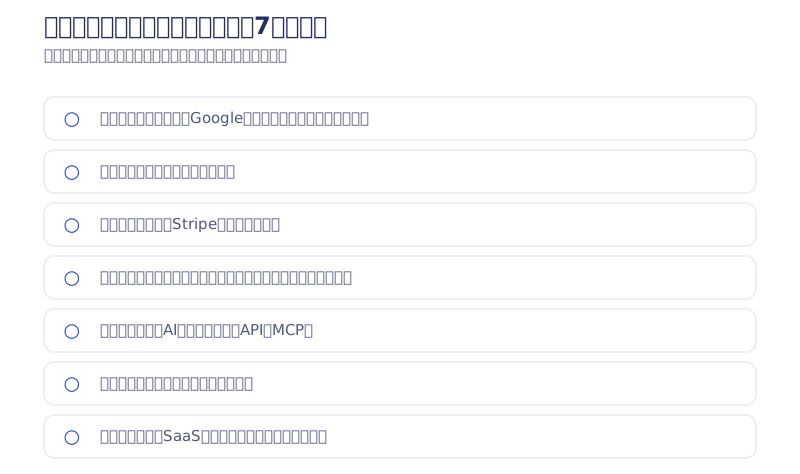
Seven things a full-stack website can do
1. Member sign-up and login work
Authentication such as Google login goes in, giving you pages only members can see and a screen for people who are logged in. Webharu’s own SaaS products use exactly this authentication pattern in production.
2. Bookings and applications complete on the site
Instead of sending people off to an outside booking service, you take bookings and applications inside the site and send the confirmation email automatically. The data stays in your own database.
3. Payments and monthly billing can be built in
One-off payments and monthly subscriptions through Stripe can be built in. Webharu runs billing on HaruCMS in production with this mechanism.
4. A database and an admin screen let you manage it in-house
Customers, bookings, orders, articles and the rest are handled in your own admin screen. It gets you out of copying things into a spreadsheet.
5. It connects to outside systems and to AI (API and MCP)
You connect to existing internal systems and outside services over an API, and if you go further and support MCP, AI such as ChatGPT and Claude can work with your service directly. There is more in API and MCP Development.
6. Notifications, reports and monitoring can be automated
Notifications for enquiries and bookings, daily and monthly reports, and site monitoring all run as programs. It removes work that someone would otherwise check by hand every day.
7. It can grow into your own service (SaaS) that you sell
Once you have members, billing, an admin screen and an API, what you have is your own service. Webharu built the email delivery API “HaruMail” and the headless CMS “HaruCMS” this way and runs both in production.
Do not build it all at once | three stages from full-scratch
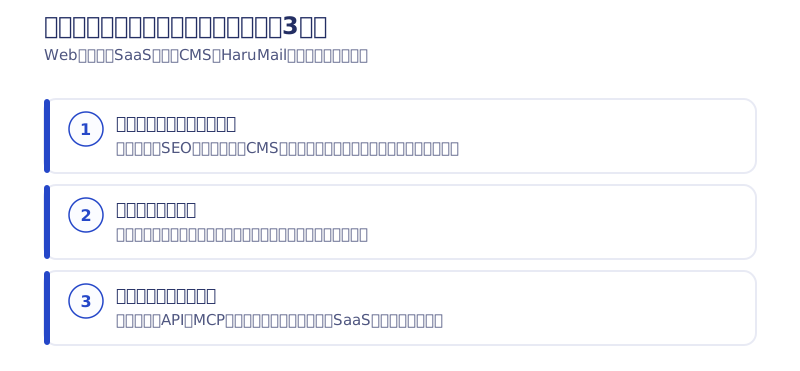
There is no need to build everything from the start. Launch a full-scratch site that is ready to grow, then add the functions the business needs in order. Webharu built its own SaaS products in that order too. Because we deliver the code, adding to it later does not mean rebuilding.
Cost and timeline | Web Application Development from ¥2,500,000
A Webharu full-stack website (Web Application Development) is from ¥2,500,000 (excl. tax), taking about 2 to 4 months as a guide (as of 2026, a starting price). That covers members, bookings, payments, database design, an admin screen and external API integrations, and the delivery of the full application plus operations documentation. The final figure is set in the requirements definition phase, and we never change the amount after work starts. A SaaS-style contract with an initial fee plus a monthly licence fee is also available under Enterprise.
The full picture on price is on the pricing page. How we build is not written up in the articles; it goes out in the corporate AI adoption manual (Japanese) (official release scheduled for 10 September 2026, with early access limited to the newsletter).
FAQ
What is a full-stack website?
It is a website that holds a working mechanism — member sign-up, bookings, payments, a database, an admin screen and external API integrations — as one piece with the site that presents. Webharu offers it as Web Application Development.
How is it different from a full-scratch website?
Full-scratch is a site that presents, designed from zero. Full-stack is that plus members, bookings, payments, a database and an admin screen. At Webharu, full-scratch starts at ¥1,000,000 and full-stack starts at ¥2,500,000 (both excl. tax, as of 2026).
What are the cost and the timeline?
From ¥2,500,000 (excl. tax) in about 2 to 4 months as a guide, a starting price. It covers members, bookings, payments, database design, an admin screen and external API integrations. The final figure is set in the requirements definition phase and does not change after work starts.
Do I have to build everything from the start?
No. Launch as full-scratch first, then add what you need — members, bookings and so on — in order. Because we deliver the code, adding to it later does not mean rebuilding.
Can a full-stack website be built in Webflow?
A composition that holds members, bookings, payments, a database and an admin screen as one piece cannot be built in Webflow alone. A full-stack site is delivered as code (Astro or Next.js).


![AI Website Cost [2026]: Our Real Prices, Published](/assets/posts/thumb-ai-website-cost.avif?v=db2fd782)