
Hi, I’m Kurita, Representative Director of Webharu Inc.. I do web production and app development in Shiogama, Miyagi, Japan, and I’ve published 6 of my own iOS apps on the App Store.
The conclusion first. The only thing you must pay to publish an app on the App Store is the Apple Developer Program’s $99 annual fee (as of October 2026; shown in Japanese yen at sign-up). Review costs $0 no matter how many times you submit, and the development tool Xcode is $0 too. In other words, “money to publish” barely exists.
So where does it actually get stuck? Not money — it’s the number of days review holds you up, and manual work that can only be done in a browser. I’ve been held up more than once with my own apps. Below is the real record, as it happened.
Key takeaways
- Apple Developer Program — what it means
- The Apple Developer Program is the annual developer agreement with Apple required to publish an app on the App Store. The annual fee is US$99 (as of October 2026; shown in local currency at sign-up). Review itself carries no fee.
Contents
Publishing an App on the App Store Costs Just the $99 Annual Fee
The only thing you pay every year to publish on the App Store is the annual fee — there are no other fixed costs.
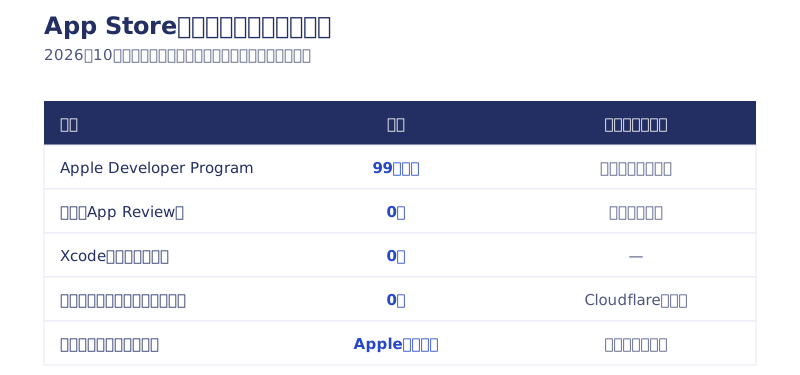
Apple’s official page states that the “annual membership fee is $99 USD (or the local currency equivalent)” (checked October 2, 2026). The yen amount moves with the exchange rate and region, so the figure shown on the sign-up screen is the correct one. And since it auto-renews, your app disappears from the store if you stop paying — the same goes for free apps.
App Review itself carries no fee. Even if you get rejected, fix it, and resubmit, that costs $0 extra. Review also requires a privacy policy URL, but hosting one costs nothing either — in fact, our meditation app’s policy sits on Cloudflare’s free tier.
Money only moves when you sell the app for a price or add in-app purchases — Apple takes its commission out of the revenue. The rate depends on your contract category and region, so check the contract screen in App Store Connect before you publish.
The Annual Fee Is the Same Whether You Register as an Individual or a Company
It’s $99 whether you register as an individual developer or as a company. Registering as a company does require a D-U-N-S Number (a number that identifies a business), though, which adds however many days it takes to obtain one.
The Record of Publishing Our Own 6 Apps on the App Store
These are the 6 apps Webharu has published. Launch dates and prices are taken straight from the App Store listing.
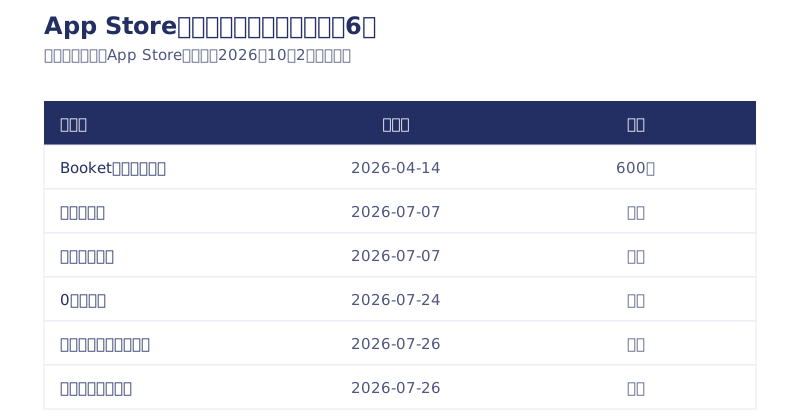
The reading-notes app Booket is paid (¥600); the other 5 are free. All of them are published within the scope of the annual fee — we haven’t paid any separate money to publish them.
Development works by having AI implement and me review it. We run it through vibe coding (Claude Code), and it takes roughly a week from concept to App Store release. Not several months — a week.
By the way, we’ve automated the submission work together with AI too. The App Store Connect API (Apple’s interface for operations like this) can handle uploading the build, entering the description, and submitting for review. Thanks to that, from the second app onward there’s almost no manual submission work left.
Why Review Got Held Up, and How Many Days It Took
A rejection doesn’t cost money — it costs days. In my experience, review results usually come back 24–48 hours after submission. So one hold-up shifts things by several days once you add the time to fix it.
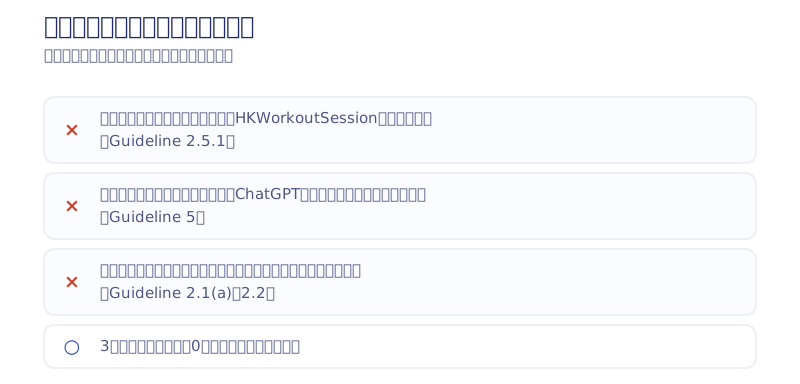
The Meditation App Got Held Up on Guideline 2.5.1
We were using HKWorkoutSession (a framework for recording exercise) to capture heart rate during meditation on Apple Watch, and got flagged for “using it without a fitness feature.” So we moved the seated meditation to a meditation-specific framework, restored only the walking meditation to the original approach per Apple’s official guidance, and wrote the reasoning in English in our review notes to get it through.
The Word “ChatGPT” in the Description Hit Guideline 5
Our photo-based calorie-tracking app (One-Shot Nutrition) got held up over mainland China regulations because the description mentioned “ChatGPT.” It was rejected on July 24, 2026; we removed mainland China from the distribution regions, resubmitted the next day on the 25th, and it went live on the 26th. We didn’t change a single line of the app itself.
A Payment Button That Didn’t Work Hit Guidelines 2.1(a) and 2.2
Our accounting app (One-Shot Keiri) was a build with payments turned off, but the paid-plan button was still there — it got held up on two counts at once: “doesn’t do anything when tapped” and “looks like a prototype.” The right answer for a build with no payments is to remove the plan screen entirely.
There Was Also a Case Where Review Passed but It Didn’t Show Up on the Store
For the meditation app, we’d set the price but forgotten to set “availability,” so even after passing review, the App Store URL wouldn’t open. Availability is a separate setting from price. Once we set it, it opened within minutes.
Three Tasks That Can Only Be Done in a Browser
Most of submission can be automated, but there are three tasks that can only be done in the App Store Connect browser interface.
- The age rating questionnaire
- App Privacy (declaring the data you collect) — you have to click the “Publish” button after answering, too
- For health-related apps, declaring whether it counts as a medical device
Also, the full text of a rejection reason can only be read in the browser — the API only gives you the status, and sometimes Apple’s email never arrived. If you get held up, open App Store Connect first.
We’re careful about trademarks too. For Token Map, we decided not to put the game’s registered trademark in the app name or subtitle, because that risks rejection under review guidelines 4.1 and 5.2.
What Keeps Costing Money After You Publish on the App Store
The only money that recurs every year after launch is the annual fee renewal. The work, though, keeps coming.
Every time you bump the version for an iOS update or a new feature, you submit for review again. As the figure above shows, the meditation app is up to 1.7.0 and Booket to 2.2.2. If an app has a server, that usage cost is separate too — for example, Token Map crawls exhibition information server-side every morning, so there’s operational work tied to that.
AI App Development Cost, and How to Read a Quote When Outsourcing
From here, this is for anyone who wants to outsource an app meant for the App Store.
App development is generally quoted around ¥1,000,000–5,000,000 (source: System Kanji). Most quotes are built as “person-month unit price × headcount × months,” and the typical person-month unit price runs ¥400,000–1,600,000 (source: Iridge).
| App scale | Roughly what it contains | Typical market rate |
|---|---|---|
| Simple tool | Recording, calculating, displaying | ¥1,500,000–4,000,000 |
| Mid-size | Membership, database integration | ¥4,000,000–10,000,000 |
| Large | Payments, complex business systems | ¥10,000,000 and up |
The table above is the general market rate we publish on our app development page. All 6 of Webharu’s own apps fall into the “simple tool” category.
The Technical Gap Has Nearly Disappeared
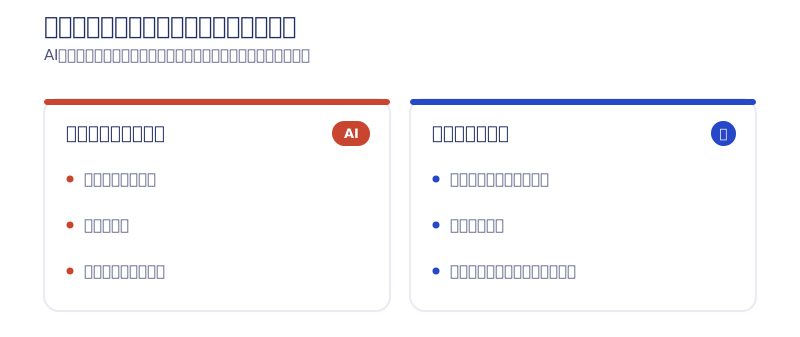
Here’s something people in this industry won’t love hearing. I think there are almost no companies left in this industry that don’t use AI in development. And honestly, my own experience is that AI builds something better than human hands alone can (3D and open-world work is still hard, though).
So what creates a difference is the planning that decides what to build. If you’re outsourcing, try asking three questions: “Do you use AI in development?” “Which stages do you use it in?” and “Who does the review?” If a company that clearly uses it dodges those questions, they may be making the timeline look longer than it is.
Before You Build, Check Whether You Can Avoid Building at All
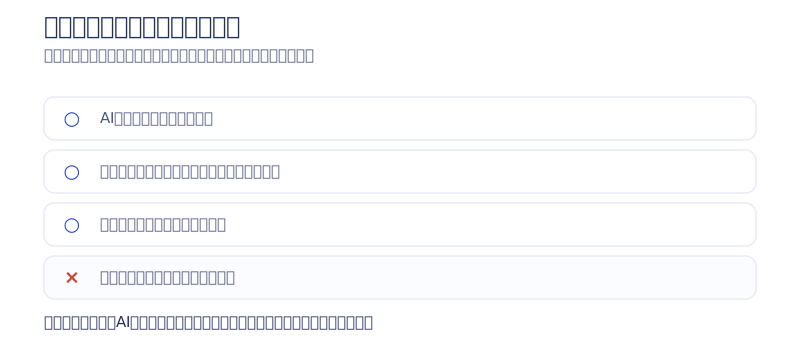
If an existing SaaS or spreadsheet integration is enough, that’s the biggest saving there is. If you do decide to build, ship a minimum setup that solves just one problem, then add to it as you use it. Features built on imagination mostly go unused.
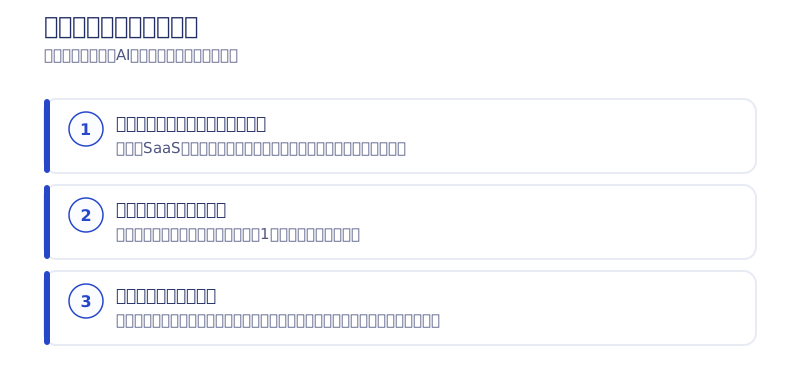
When comparing quotes, check how far they go — requirements definition, design, development, testing, and maintenance — whether the annual fee and server costs are billed separately, and which side keeps the rights to the source code. If you ask Webharu, we give a rough estimate after a hearing, and we tell you every recurring real cost, like the annual fee, on the spot.
Conclusion: Read the Review Timeline, Not Just the App Store Publishing Cost
The cost of publishing an app on the App Store is just the $99 annual fee. Review and resubmission are both $0. What creates a difference is whether you can head off the things that hold up review before you submit, and whether you can keep pushing new versions after launch.
I keep adding every pitfall I hit developing and submitting our own apps to a running note. I publish the ones useful to developers first in the newsletter, so if you’re publishing your own app, sign up there. You can find how we build with Claude Code in the vibe coding article, and how to build using only a browser in the article on building an attendance app with Figma Make. If you’d like us to handle your app development, reach out through the consultation form.
Selected work

Hosted by Nippon TV
High-fidelity Figma-to-Webflow conversion, with load speed and responsiveness optimized

PonTech Lab Inc.
Built with AI (Claude Code) on Next.js and Cloudflare, with the build process published

JTB Americas
A full renewal of the North America site, with the operations team able to update it themselves
FAQ
How much does it cost to publish an app on the App Store?
Just the Apple Developer Program’s $99 annual fee (as of October 2026; shown in Japanese yen at sign-up). There’s no review fee, and the development tool Xcode is free too. Apple only takes a cut from your revenue if you sell the app or offer in-app purchases.
How much is the Apple Developer Program in Japanese yen?
Apple’s official page states US$99 (or the local-currency equivalent), and the yen amount moves with the exchange rate and your region. The figure shown on the sign-up screen is the correct one. It renews automatically every year.
Does review cost money? What if I get rejected?
No. Fixing something and resubmitting after a rejection is free. But results often take 24–48 hours, so one hold-up can push things back by several days. Even our own apps got held up three times.
Can I publish an iOS app as an individual developer?
Yes. The annual fee is the same $99 whether you register as an individual or a company. Registering as a company requires a D-U-N-S Number, which adds extra days just to obtain it.
Do I need to pay the annual fee even for a free app?
Yes. A free app still costs the $99 annual fee, and if you stop renewing, it disappears from the store. Webharu’s Token Map and meditation app are both free, but we keep paying the annual fee.
What changes when you develop an app with AI?
The timeline changes. Our own apps went from concept to App Store release in about a week. The general market rate is said to be ¥1,000,000–5,000,000, and since the outsourced price depends on your requirements, we provide a rough estimate after a hearing.


![Custom Website vs Web App | Full-Scratch or Full-Stack? [Cost, Timeline, Fit]](/assets/posts/thumb-full-scratch-vs-fullstack.avif?v=2b619e52)