

![AI Overviews Optimization Across 63 Articles [Report #1]](/assets/posts/thumb-aio-field-report-1.avif?v=0c19cab8)
- AI Overviews — what it means
- AI Overviews is a Google Search feature that displays an AI-generated answer, summarized from multiple web pages, at the top of the results page. Work aimed at making your own pages more likely to be cited in that answer is called AIO optimization.
Hi, I’m Masato — a Webflow specialist who now chases the leading edge of AI.
In July 2026 I rolled out AI Overviews optimization (AIO) across all 63 articles on our company blog at once. This series is the record of what I implemented and what results it produces, published with the measured data. Part 1 is the implementation. What I added, how I applied it to 63 articles in one pass, and what I will treat as proof that it worked.
✓ In this article
- What AIO (AI Overviews) is, in one sentence
- The six measures rolled out across 63 articles
- How AI (Claude Code) applied them in a single pass
- The measurement design and the current baseline
Here is the conclusion first. The implementation is done. But no results have come in yet. There are plenty of articles that declare “this is what works for AIO,” yet very few of them seem to be verified with measured data. So I decided to run the experiment on my own 63-article blog and publish the numbers.
What AIO (AI Overviews) is
AI Overviews is a Google Search feature that displays an AI-generated answer, summarized from multiple web pages, at the top of the results page. It appears more and more often in Japanese search results, and since September 2025 the conversational “AI Mode” has supported Japanese as well.
“AIO optimization,” as used in this article, means the work of making your own articles more likely to be cited or referenced inside that AI answer. If you include traffic arriving via ChatGPT, you can treat it as essentially the same territory as what people call LLMO or GEO.
For the record, Google’s official documentation takes the position that no special measures for AI features are needed and that following conventional SEO best practices is enough. I went and did the work anyway because “shaping content so AI can summarize and cite it” overlaps almost entirely with conventional SEO — there is no downside.
Why do it now
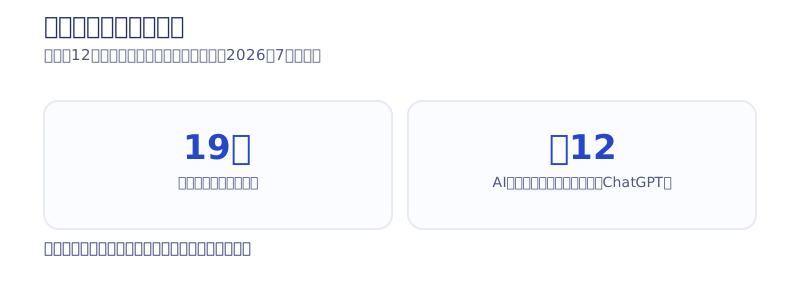
My blog gets 190,000 impressions a year. Meanwhile, the AI-sourced traffic visible in GA4 is about 12 sessions a month. Essentially zero (and almost all of it is ChatGPT).
If the entrance to search is going to be replaced by AI, I want a record of how that “12” moves, starting now. If there is no effect, I will write that there was none. That is data too.
The six measures rolled out across 63 articles as AIO optimization
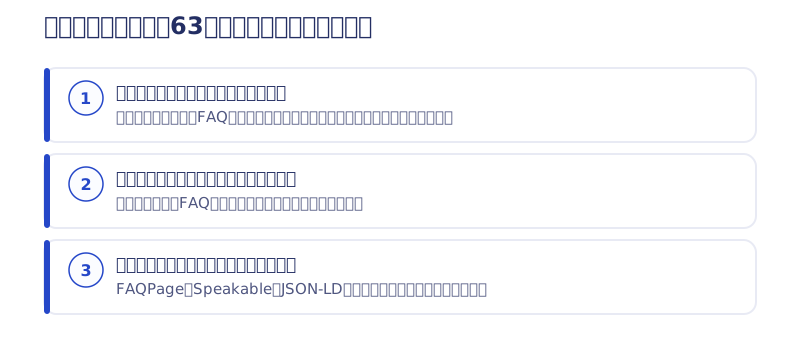
- Key Takeaways box I placed three to five bullet points at the top of each article. There is one rule: the first line answers the question in the title directly. If the title is “why I chose X,” the first line states the reason itself. The aim is that AI finds the opening summary easy to quote.
- FAQ plus FAQPage structured data I added three to five questions to each article and made the FAQPage JSON-LD output automatically. A question can itself become a search query or a question put to an AI, so each expected question gets a one-to-one answer.
- One-sentence definition (“X is …”) I added a box defining the article’s subject in a single sentence: “X is ….” It is a shape AI can lift out and cite as a definition.
- Speakable structured data This is a schema that marks passages suited to being read aloud. Support is still limited, but it can be generated automatically from the takeaways data, so I added it at almost zero extra cost.
- llms.txt A text file that guides AI crawlers to the site’s structure and main pages. Standardization is still in progress and the effect is unknown, but the cost is low, so it is in place.
- Improved meta descriptions I reviewed every article for descriptions that were empty, too short, or too long. It is unglamorous, but it directly affects how you look in search results, AI aside.
There were side effects too. Machine-reading every article turned up more than 450 typos and inconsistent spellings, all fixed in one pass. Three pairs of overlapping articles were consolidated with 301 redirects. Honestly, that work should have been done regardless of AIO.

How it was applied in one pass: designing the AI work for LLMO implementation
Do not touch the body text at all
Rewriting the body of 63 articles is not realistic, and I did not want my own first-hand accounts rewritten by AI. So the design is: leave the body text untouched and add structured fields to the article data.
- Add “takeaways,” “FAQ,” and “one-sentence definition” fields to each article’s data
- Have the template generate the visible boxes and the FAQPage/Speakable structured data from that data automatically
Because the visible output and the structured data come from the same source, they never drift apart. Hand-maintaining JSON-LD across 63 articles is impossible, so I solved that structurally.
Generation ran as parallel AI agents — under strict rules
The contents of the takeaways, FAQ, and definitions were generated by running several agents in parallel in Claude Code. I imposed two rules on them.
- Use only what is written in that article as the basis. Do not add new facts or numbers
- For first-hand accounts, keep my own phrasing (no AI invention mixed in)
My blog has been built on experience and numbers, so if AI fabricated facts the whole thing would collapse. That constraint was the lifeline of the whole rollout.
After implementation, scoring every article against my own checklist moved the average from 47.8 to 97.3. Don’t misread that, though: it measures how thoroughly the implementation landed, by our own standard. It is not a search result. Results will be confirmed with numbers from here on.
Incidentally, this site itself was fully rebuilt with AI (Claude Code) over 7 days, and the whole process is documented in a separate article.
Measurement design: what counts as proof that it worked
To avoid firing and forgetting, I decided which numbers to watch in advance.
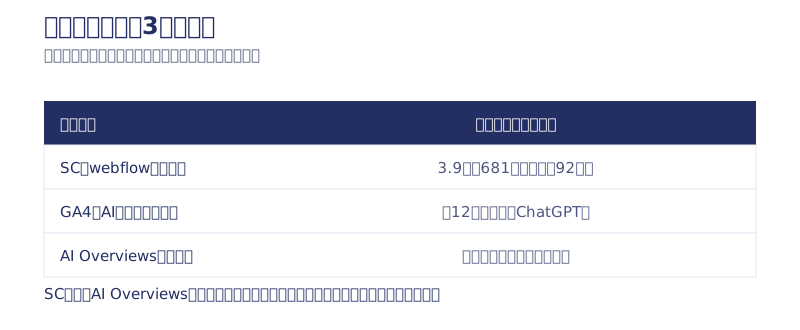
- Impressions and position in Search Console Over the last 92 days, the query “webflow” sits at position 3.9 with 681 clicks and 15,084 impressions. That is our flagship, so I will watch movement around it first. Note that, according to the official help, impressions and clicks arriving via AI Overviews are aggregated together with regular search results in Search Console. In other words there is no metric that directly shows “were we cited in AIO” — it can only be tracked indirectly.
- AI-sourced sessions in GA4 Referral traffic from chatgpt.com and similar. The current baseline is about 12 sessions a month (almost all ChatGPT). It is the clearest indicator, so I will track it monthly (the procedure for measuring it in GA4 is in our article measuring ChatGPT traffic).
- Fixed-point observation on the search screen itself I will check on the actual search screen whether our articles get cited in AI Overviews for our target queries.
The implementation was in July 2026, so the comparison is “before” versus “after.” Algorithm updates and seasonal factors cannot be fully separated out, though, so I will avoid firm claims and report the conditions honestly along with the numbers.
Part 2 is the results. The newsletter gets it first
To repeat: as of now, no results have appeared. Whether they do or they don’t, I will publish the numbers either way. The 63-article test bed is ready; all that is left is to wait for the numbers.
Part 2 will go out first in our newsletter, “A public experiment in growing a blog with AI” (Japanese), and appear on the blog afterwards. If you want to run the same experiment on your own site, follow along there. If you would rather hand the whole implementation over, start with a free consultation.
FAQ
What does AIO optimization actually involve?
It is the work of making your pages more likely to be cited or referenced in answers from Google’s AI Overviews and from tools like ChatGPT. The author started with takeaway boxes, FAQs, one-sentence definitions, structured data, and llms.txt.
Does AIO optimization work?
As of this article, it is not yet known. This is Part 1 (implementation) of a series measuring the effect of a single rollout across 63 articles; the pre-implementation baseline is about 12 AI-sourced sessions a month. Whether it worked will be published separately as the results installment.
Do I need to rewrite the body text of existing articles?
The author did not rewrite the body text. Adding takeaway, FAQ, and definition fields to the article data and having the template generate the display and structured data lets you apply the change to every article with the body left as it is.
Was the FAQPage and Speakable structured data written by hand?
No. It is generated automatically by the template from the FAQ and takeaways stored in each article’s data, because hand-maintaining JSON-LD across 63 articles is not realistic.


